Black Granite Jalaram Bapa Singhasan Darshan Murti 21in
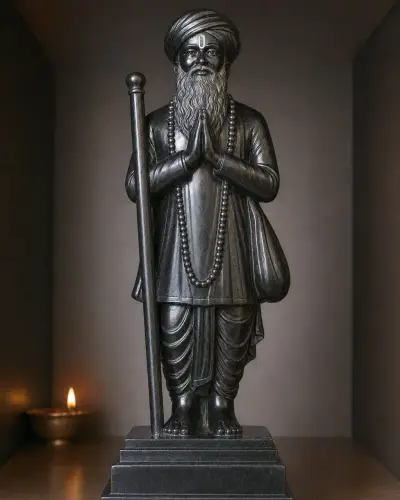
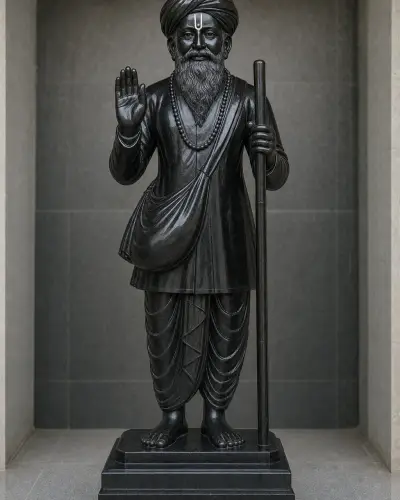
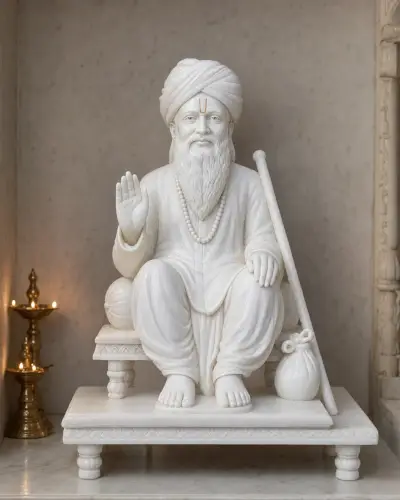
Master-carved black granite Jalaram Bapa in seated darshan on a singhasan, a 21-inch home mandir murti with a mirror-polished finish.
Made to order. The pictures here are concept images. This is not a ready item. We get it made for you as per this design, as close as possible, in the size and stone you choose.
Want this design made for you?
Tell us the size, the stone and where it is going. We will send you a quote and a timeline.
Chat on WhatsAppWe'll respond within 5 minutes
About This Piece
Who Jalaram Bapa is, and how he is shown
Jalaram Bapa (1799 to 1881) lived at Virpur in Saurashtra, where the sadavrat he opened has fed anyone who arrives, without charge, for close to two centuries. Devotees across Gujarat and the Gujarati diaspora keep his image in the home mandir rather than in a temple hall, which is why his murti is usually made at a scale a shelf can carry. This one holds the form Virpur made familiar: seated in relaxed darshan on a singhasan with a scrolled backrest, the right hand raised in blessing, the left hand at rest on the armrest, feet forward on the throne step rather than folded in padmasana. The wound Kathiawadi turban, the long white beard reaching the chest, the long-sleeved kediyu over a dhoti, the cloth jholi at his side, and the Vaishnav U-tilak with a tulsi kanthi are all cut into the stone, not painted on.
The stone
Black granite is the stone of the South Indian temple workshops, where dark igneous rock has carried deity images for more than a thousand years, and it behaves differently from marble in a working mandir. It is dense and effectively non-porous, so oil from a diya, ghee and the water of an abhishek sit on the surface instead of soaking in, and a wipe returns the piece to where it started. It also takes a deeper polish than almost any other natural stone. Here the finish is a full mirror polish, which turns the drapery folds of the dhoti and the scrollwork of the singhasan into long unbroken highlights and leaves the beard and the turban reading as texture against them. The colour is a true jet black with no veining; a black granite piece should never drift brown, grey or green.
Sizing it for your mandir
At 21 inches this sits at the scale most Gujarati households actually use: tall enough to be the single focus of a home mandir, small enough that it does not need a room of its own. Plan for roughly 12 inches of width across the singhasan arms and 10 inches of depth once the stepped plinth is counted, then give the shelf a little more than that so the plinth is not flush with the front edge. It weighs about 32 kg in black granite, which is a two-person lift and asks for a stone, hardwood or masonry shelf rather than a hollow-backed cabinet. The raised blessing hand reads best when the face sits near the eye line of someone standing, so a shelf 40 to 48 inches off the floor usually works.
Making it yours
This is a design, not a fixed shelf item, and the same murti can be re-cut to your dimensions. Jalaram Bapa works equally well in Makrana white marble or Vietnam white marble if your mandir is already light-toned, in Dholpur pink sandstone for a warmer, matte reading, or in cast marble dust at a smaller scale. The finish can drop from mirror polish to a soft satin if you want less reflection near a lit diya. The plinth can be stepped, left plain, or engraved with a family name and a date for a griha pravesh or a mandir installation. Tell us the shelf you are filling and the master sculptors we work with will cut it to fit. We design it with you, brief them, and follow the piece through to your door.
Specifications
Pose
Seated in relaxed darshan on a carved singhasan throne with a scrolled backrest — right hand raised in blessing, left hand resting on the armrest, feet forward on the throne step
Color
Black
Finish
Mirror polish
Material
Black Granite
Ideal For
Home mandir, Temple installation, Collector piece
Weight In Kg
32
Depth In Inches
10
Width In Inches
12
Height In Inches
21
Region Or Tradition
Indian / Gujarati (Virpur, Saurashtra Vaishnav sant tradition)