Black Granite Jalaram Bapa Standing Murti 30in
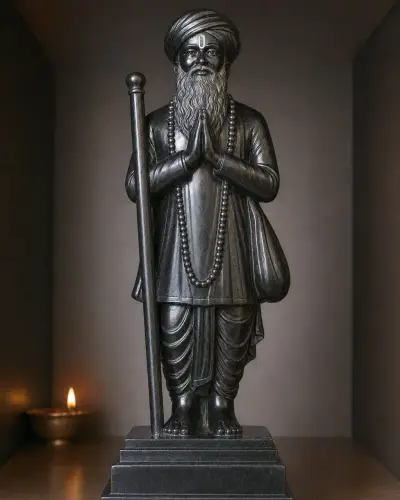
Master-carved black granite Jalaram Bapa in standing ashirwad. A 30-inch home mandir murti with the jholi across his chest and danda in hand.
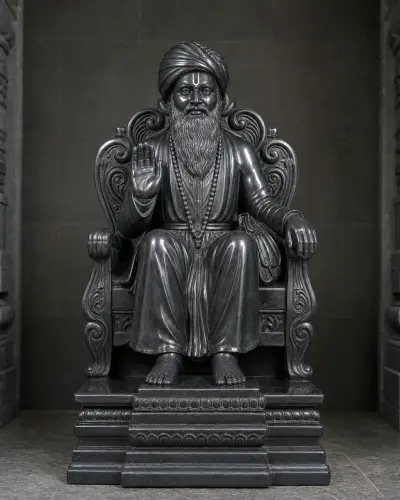
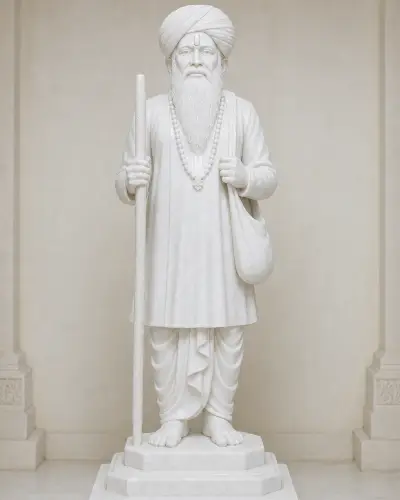
Made to order. The pictures here are concept images. This is not a ready item. We get it made for you as per this design, as close as possible, in the size and stone you choose.
Want this design made for you?
Tell us the size, the stone and where it is going. We will send you a quote and a timeline.
Chat on WhatsAppWe'll respond within 5 minutes
About This Piece
Who this Jalaram Bapa murti depicts
Jalaram Bapa (1799 to 1881) was born at Virpur in what is now Rajkot district, Gujarat, and gave his life to a sadavrat: an open kitchen that fed whoever arrived, without asking name or caste. He took initiation from Bhoja Bhagat of Fatehpur, and his wife Virbai Ma is remembered as an equal partner in that work rather than a bystander to it. The shrine at Virpur still serves food every day and stopped accepting cash offerings altogether in the year 2000, and Gujarati families across Saurashtra, Mumbai, East Africa and the United Kingdom keep his image at home. A murti of Jalaram Bapa shows a householder saint, not a deity: no crown, no vahana, no extra arms, and none of the ornament a Vishnu or Devi form would carry.
Reading Jalaram Bapa's attributes
Jalaram Bapa is recognised anywhere in the world by two objects. The jholi, the cloth alms bag slung across his chest, is the sadavrat itself, carried rather than kept. The danda, the plain wooden staff standing upright beside him, belongs to the walking mendicant he stayed even after the kitchen made his name. Around them sit the details a Gujarati devotee looks for first: the wound Kathiawadi turban, the long full beard down to his chest, the long-sleeved kediyu worn over a dhoti, the U-shaped Vaishnav tilak on the forehead and the tulsi kanthi at the throat. He is often mistaken for Sai Baba of Shirdi in print and online; the knotted head cloth, close-trimmed beard and single draped kafni of Shirdi belong to a different sant altogether. On this piece the right hand rises palm-out in ashirwad while the left steadies the danda.
Black granite, and why it suits this murti
Black granite is igneous stone. It is harder and denser than marble, very fine in grain, and free of the veining that runs through a marble block. It is one of the few stones that will take a true mirror polish, and this piece is finished to one: light travels the drape of the kediyu and the folds of the jholi as a single long highlight instead of scattering into hotspots. On a figure whose whole character is plainness, that reflectivity does the ornamental work: there is no jewellery to catch the eye, so the stone carries it. Granite also handles what a working home mandir does to a surface. Lamp soot, ghee, kumkum and water wipe off polished granite without staining or etching it, which is why South Indian temples have carved in it for centuries.
Sizing the murti for your space
At 30 inches (two and a half feet), the piece stops being a shelf object and starts holding a room. The plinth footprint is about 12 inches by 10, and in granite it comes to roughly 62 kilograms, so it asks for a floor, a stone ledge or a masonry platform rather than a wooden shelf or a wall bracket. An entrance alcove suits it well: the ashirwad hand reads from several feet away, and dark stone keeps its silhouette against a pale wall. For a compact mandir room the same standing form works at 15 or 18 inches, and for a community hall or a Jalaram Jayanti pandal it goes past four feet without thinning out the carving.
Making this Jalaram Bapa murti yours
This form is a starting point rather than a fixed catalogue item. The same standing figure can be carved in Makrana white marble, Vietnam white marble or cast marble dust, at whatever height your space takes, with the plain moulded plinth swapped for a lotus base or a stepped temple platform. Families commissioning for a shrine often ask for a name and a date cut into the plinth edge. Tell us the height, the stone and where the murti will stand, and we will design it with you, brief the sculptor who carves it, and follow the piece through to your door.
Specifications
Pose
Standing on a plain moulded plinth, the cloth jholi slung across his chest and the wooden danda held upright in his left hand, the right hand raised palm-out in ashirwad, in a wound Kathiawadi turban and long full beard, a long-sleeved kediyu over a dhoti, with a U-shaped Vaishnav tilak and a tulsi kanthi
Color
Black
Finish
Mirror polish
Material
Black Granite
Ideal For
Home mandir, Living room, Collector piece
Weight In Kg
62
Depth In Inches
10
Width In Inches
12
Height In Inches
30
Region Or Tradition
Indian / Gujarati (Virpur, Saurashtra Vaishnav sant tradition)