Makrana White Marble Jalaram Bapa Temple-Scale Murti 48in
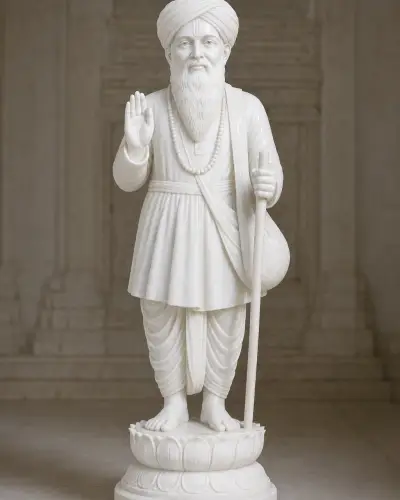
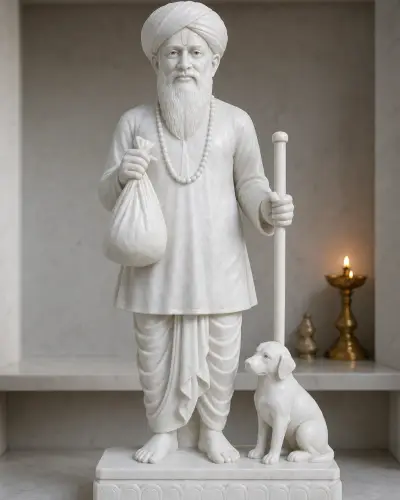
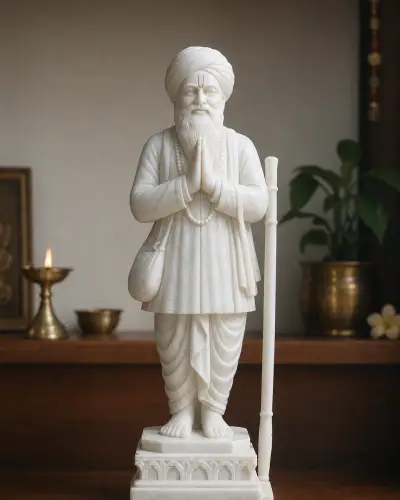
Master-carved Makrana white marble Jalaram Bapa in the standing Virpur form, a 48-inch temple-scale murti with danda and shoulder jholi.
Made to order. The pictures here are concept images. This is not a ready item. We get it made for you as per this design, as close as possible, in the size and stone you choose.
Want this design made for you?
Tell us the size, the stone and where it is going. We will send you a quote and a timeline.
Chat on WhatsAppWe'll respond within 5 minutes
About This Piece
The Makrana marble behind this murti
Makrana white marble comes out of the quarries at Makrana in Rajasthan's Nagaur district, the same belt that supplied the Taj Mahal and has been worked continuously for centuries. It is a dense calcite marble with a fine, lightly sugary crystal, compact enough to hold a beard curl or a fingernail edge without crumbling, and translucent enough that light sinks a little way into the surface before it comes back. Grey hairline veining runs through it sparingly, never wide enough to cut across a face. This murti is finished to a soft satin polish rather than a full mirror gloss, which keeps the chisel modelling on the drapery readable instead of flattening it under reflections, and lets the stone hold its natural warmth under the lamps of a sanctum.
Reading the Jalaram Bapa form
Jalaram Bapa (1799 to 1881) of Virpur in Saurashtra is remembered for the sadavrat, the free kitchen he kept open at his home, where anyone who arrived was fed. The two objects that identify him carry that story: the wooden danda planted upright at his right side, and the cloth jholi slung from his left shoulder, the bag he carried when he gathered grain for the kitchen. Above them he wears the wound Kathiawadi turban and a long-sleeved kediyu over a white dhoti, with a full beard reaching his chest. On the forehead sits the Vaishnav U-shaped tilak and at the throat a tulsi kanthi, placing him in the Rama-bhakti tradition he followed all his life. Nothing here is stylised; the carving stays with the form devotees recognise from Virpur.
Placing a 48-inch murti in a sanctum
At 48 inches the murti stands a little over four feet, which is temple scale rather than home-shrine scale: it reads correctly from across a hall and holds its own against a sanctum's pillars. The figure is roughly 14 inches across the shoulders and 14 inches front to back at the plinth, and weighs close to 24 kilograms, so it belongs on a masonry or stone base rather than a wooden table. Allow a foot of clear floor in front for aarti and garlanding, and keep the eye line of a standing devotee somewhere between the chest and the face. A plinth of six to nine inches usually gets that right. A lamp set low and to one side draws out the folds of the dhoti; one placed flat in front tends to flatten the beard.
Making this Jalaram Bapa murti your own
Every piece is made to order, so this one can be shaped around the sanctum it is going into. Height is usually the first change: the same standing form works at 24 or 36 inches for a home mandir, and larger than 48 inches for a hall. The stone can move to Vietnam white marble for a cooler, flatter white, or the finish from soft satin to a fuller polish. The plinth can be plain, moulded or stepped, and an engraved line on its face (a family name, a date of installation, a dedication) is a common request on a murti gifted to a temple. Tell us the space and the stone you have in mind; we design it with you, brief the sculptor who carves it, and follow the piece through to your door.
Specifications
Pose
Standing at temple scale on a stepped plinth, wooden danda upright at his right side and cloth jholi over his left shoulder, in a wound Kathiawadi turban, kediyu and dhoti, with a Vaishnav U-shaped tilak and tulsi kanthi
Color
White
Finish
Soft polish (satin)
Material
Makrana White Marble
Ideal For
Temple installation
Weight In Kg
24
Depth In Inches
14
Width In Inches
14
Height In Inches
48
Region Or Tradition
Indian / Gujarati (Virpur, Saurashtra Vaishnav sant tradition)