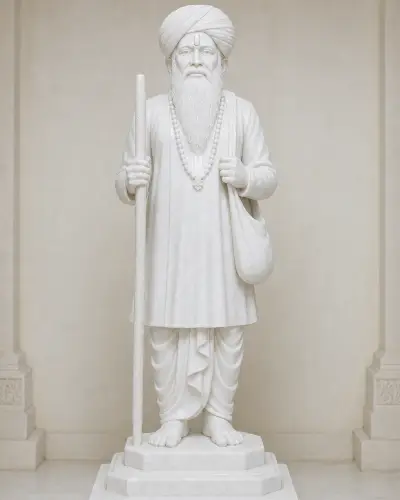
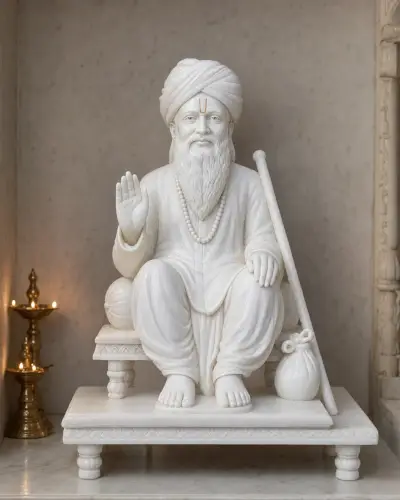
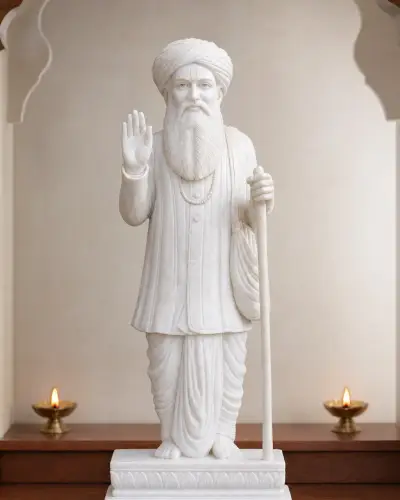
Makrana White Marble Jalaram Bapa on Lotus Plinth 36in
Sculptor-carved Makrana white marble Jalaram Bapa in ashirwad: a 36-inch standing murti on a lotus plinth with the jholi and danda.
Made to order. The pictures here are concept images. This is not a ready item. We get it made for you as per this design, as close as possible, in the size and stone you choose.
Want this design made for you?
Tell us the size, the stone and where it is going. We will send you a quote and a timeline.
Chat on WhatsAppWe'll respond within 5 minutes
About This Piece
Makrana marble for a sant murti
Makrana stone is quarried in Nagaur district, Rajasthan, from the same beds that supplied the Taj Mahal, and it has been the working stone of temple sculpture across this region for centuries. It reads as a bright natural white with the faintest cream undertone, and its close crystalline grain is what lets a sculptor separate the individual strands of a long beard or the wound layers of a turban without the edges powdering away. On a sant murti that quality earns its keep, because the whole piece stands or falls on the face being recognisably Jalaram Bapa. For this 36-inch statue the block is picked for an even body of stone with no more than hairline grey veining, so what veining there is falls across the dhoti and the plinth rather than through the features. The soft satin polish holds lamp light as a glow rather than a hard flare.
The form: turban, beard, jholi and danda
Jalaram Bapa of Virpur stands on a carved lotus-petal plinth, his right hand raised in ashirwad and his left hand closed around the wooden danda. Four marks fix his identity and all four are cut into the stone: the wound Kathiawadi turban, the long full beard falling to his chest, Gujarati dress (a white dhoti under a long-sleeved kediyu that keeps the upper body covered), and the cloth jholi slung across the shoulder. The jholi and danda are not ornament. They are the emblems of the Sadavrat, the free kitchen he opened at Virpur in 1820, which has fed travellers and pilgrims without interruption since. A U-shaped Vaishnav tilak marks the forehead and a tulsi kanthi rings the neck. Devotees often ask how to tell this murti from a Shirdi Sai Baba: here the turban is wound rather than knotted at the shoulder, the beard is long rather than short, and the dress is Gujarati, not a kafni.
Three feet, in a temple hall or a home mandir
Three feet is the working height for a murti that has to hold a room. In a temple hall the statue reads clearly from the back of the space once it is raised on a chowki or stone platform of about 18 to 24 inches, which brings the ashirwad hand close to the eye level of a standing devotee. At home the same 36-inch piece suits a dedicated mandir room or a wide alcove rather than a shelf: allow roughly 11 inches of shoulder width, the same again in depth, and a little clearance behind for the danda. Jalaram Bapa is commonly installed facing the entrance of the room, so that the raised hand meets whoever walks in. A plain wall behind the murti does more for the carving than a patterned one, and a single warm lamp set low and to one side brings out the folds of the kediyu.
Making it yours
Every piece here is made to order, so this specification is a starting point rather than a fixed catalogue item. Height moves either way, smaller for a home mandir shelf and larger for a hall or a Sadavrat kitchen, and the same form can be carved in Vietnam white marble or in black stone where a darker figure suits the room. The plinth is open to change too: a plain moulded base instead of the lotus, a taller pedestal carved as one piece with the murti, or a flat base face left for an engraved dedication when the statue is being given to a mandir. Tell us what the space is and how far back people will stand, and we brief the sculptor with the proportions set for that room. A photograph of the niche or platform sent over WhatsApp makes it quicker still.
Specifications
Pose
Standing on a lotus-petal plinth, right hand raised in ashirwad, left hand on the danda, jholi across the shoulder
Color
White
Finish
Soft polish (satin)
Material
Makrana White Marble
Ideal For
Temple installation, Home mandir
Weight In Kg
18
Depth In Inches
11
Width In Inches
11
Height In Inches
36
Region Or Tradition
Indian / Gujarati (Virpur, Saurashtra Vaishnav sant tradition)