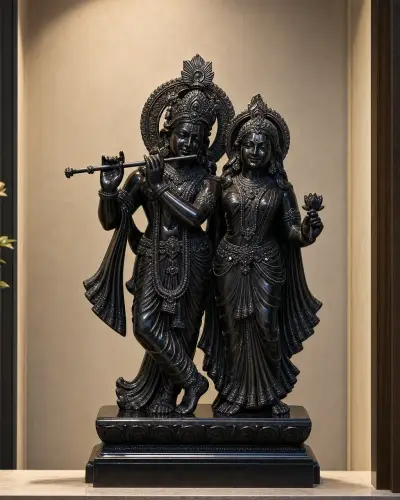
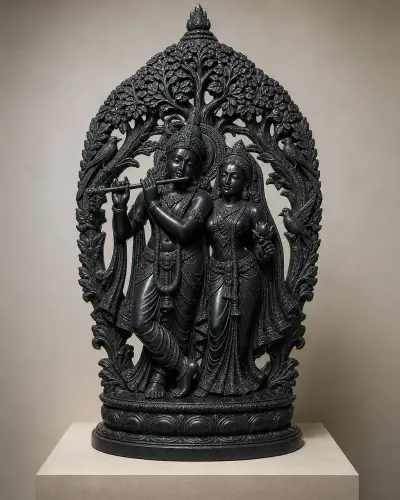
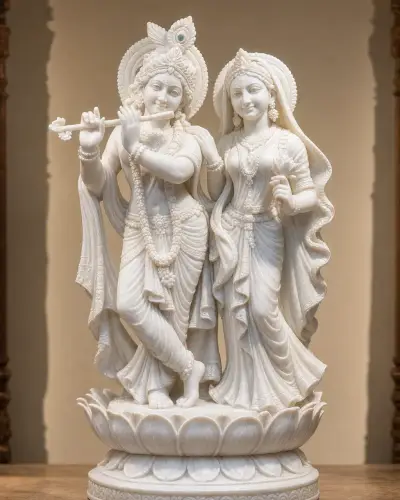
Handcrafted Black Granite Radha Krishna Seated Pair on Carved Chowki, 21-inch
Seated rather than standing, this 21-inch Radha Krishna pair on a carved chowki is cut in jet-black granite for a low mandir shelf.
Made to order. The pictures here are concept images. This is not a ready item. We get it made for you as per this design, as close as possible, in the size and stone you choose.
Want this design made for you?
Tell us the size, the stone and where it is going. We will send you a quote and a timeline.
Chat on WhatsAppWe'll respond within 5 minutes
About This Piece
Why this jugal jodi is seated, not standing
Almost every Radha Krishna jugal jodi is carved standing. This one sits. Krishna is cross-legged on a carved chowki with the bansuri held across his lap rather than raised to his lips, and Radha is beside him on his left, one hand resting on his shoulder. The change of posture changes what the piece does in a room: a seated pair drops the sightline, settles into a shelf instead of towering over it, and reads as company rather than darshan. At 21 inches including the chowki, it suits a mandir niche where a standing pair of the same presence would need half a foot more headroom.
The black granite and its mirror polish
The stone is black granite, the dense, close-grained igneous stone that South Indian sculptors in the Dravidian temple tradition have worked for centuries, chosen because it takes fine detail without chipping at the edges. Polished to a mirror, it stops scattering light and starts returning it: one soft source travels across Krishna’s shoulder and the fall of Radha’s veil as a single unbroken highlight, and the carved jewellery holds its shadow instead of washing out. Black stone is unforgiving of a lazy cut, which is exactly why it flatters a careful one.
How the pair and chowki are carved
The pair is carved for you by the master sculptors we work with in Jaipur, and the figures and the chowki come out of one block, with the seat, scrollwork apron and cabriole legs included, so there is no join to open up years later. The mass is roughed out first, then the seated geometry is cut: crossed shins, the pleats spilling over the edge of the seat, the pocket of air between Radha’s arm and Krishna’s shoulder. Faces, fingers and the flute are finished entirely by hand. The polish runs through progressively finer grits until the black closes, while the recessed ornament is left a shade softer so the detail stays readable rather than dissolving into glare.
The Braj tradition behind a seated pair
Seated forms of the jugal jodi belong to the Braj devotional tradition around Vrindavan, where Radha and Krishna are worshipped as one indivisible pair rather than as deity and consort. Krishna keeps his identifying attributes, the bansuri and the peacock-feather crest in his mukut, while the resting flute marks the seated form specifically. Radha’s hand on his shoulder is the gesture the whole composition is built around, and neither figure is seated higher than the other.
Lighting it, and changing size or stone
Black stone wants directed light. One warm downlight, or a diya set to either side, will pick up both the polish and the carving; flat overhead lighting flattens it. Against a pale wall the silhouette reads cleanly, and against dark panelling a light backing cloth will separate the crowns from the background. Leave a hand’s width of clearance behind the halos so the finials are not lost. The same seated composition can be commissioned taller or shorter, in Makrana or Vietnam white marble for a lighter reading, or with the chowki apron carved to a motif you choose. Send us the shelf dimensions you are working to and we will design it around them, brief the sculptor, and follow it through to your door.
Specifications
Pose
Radha and Krishna seated side by side on a carved chowki — Krishna cross-legged with the flute held across his lap, Radha at his left with one hand resting on his shoulder, both crowned
Color
Black
Finish
Mirror polish
Material
Black Granite
Ideal For
home mandir, pooja room
Weight In Kg
25
Depth In Inches
8
Width In Inches
15
Height In Inches
21
Region Or Tradition
Indian / Braj (Vrindavan, Vaishnava tradition)