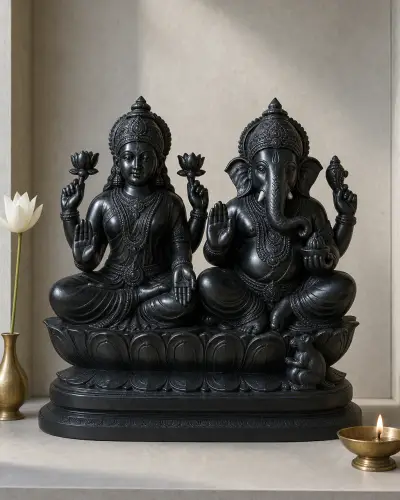
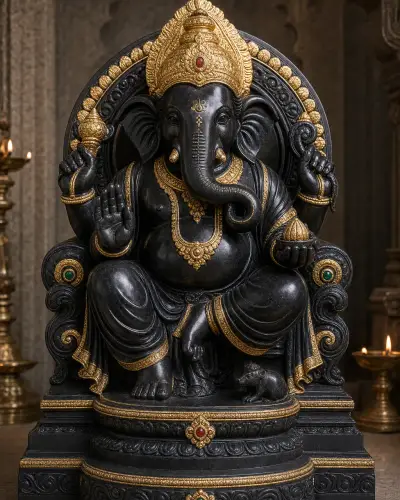
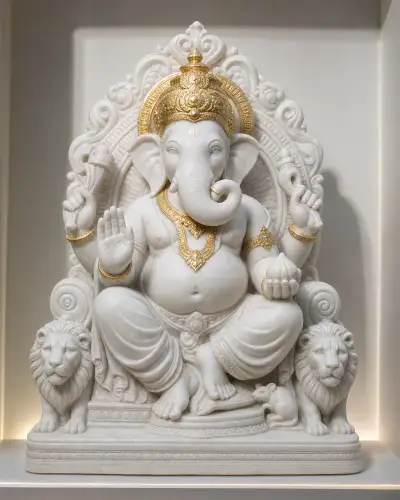
Black Marble Lalbaugcha Raja with 22k Gold Leaf on Lion Throne, 21 in
Master-carved black marble Lalbaugcha Raja on a lion-flanked simhasan. A 21-inch centrepiece with 22k gold-leaf mukut and mirror polish.
Made to order. The pictures here are concept images. This is not a ready item. We get it made for you as per this design, as close as possible, in the size and stone you choose.
Want this design made for you?
Tell us the size, the stone and where it is going. We will send you a quote and a timeline.
Chat on WhatsAppWe'll respond within 5 minutes
About This Piece
Black marble and 22k gold leaf, carved by hand
Jet-black stone and 22k gold leaf, with almost nothing in between: that is the whole idea behind this 21-inch Lalbaugcha Raja. The stone comes from the black marble belt around Markapur in Andhra Pradesh, a dark, tight-grained material quarried for temple flooring and idol work for generations. Worked up to a mirror polish it stops behaving like ordinary stone: the surface carries one long, unbroken reflection down the shoulders and across the belly, and the gold stops reading as decoration and starts reading as light.
Carving begins with a block squared to the throne's footprint, because on a Lalbaugcha Raja the throne carries as much of the composition as the figure does. Sculptors block the seated mass first, open the two flanking lions next, then come back to the face, the trunk and the folds of the dhoti with hand chisels and drill points. No machine tooling touches the face, the hands or the drapery. Polishing runs through progressively finer grits by hand until the black closes up completely. Only then is the gold leaf laid, mukut first, then the necklaces, armlets and the banded edge of the dhoti.
Why this is a Lalbaugcha Raja, not any Ganpati
Lalbaugcha Raja is not a generic Ganpati. The form belongs to the Lalbaug market in central Mumbai, where the mandal has installed the same seated, heavily crowned Ganesha since 1934. He is the Navasacha Ganpati, the one devotees come to with a vow. Its signature is the simhasan: a throne whose arms and flanks are carved as lions, which is exactly what separates this form from the lotus-seat and plain jewelled-throne Ganpatis. Everything else follows canon: four arms, trunk turned to the deity's left, a single broken right tusk, a modak in the lower hand, the right hand raised in abhaya, and the mushak resting at the foot of the throne.
Lighting and placing a 21-inch black murti
At 21 inches the piece belongs on a console, a low plinth or a dedicated shelf rather than needing a full temple around it. Black stone wants directed light: one spotlight from above and slightly to the side is what makes the gold leaf and the mirrored surfaces work, where flat ambient light simply flattens them. Leave roughly a foot of clear wall behind it so the crown silhouette reads, and keep it off a dark panel, which swallows the outline. East or north-east facing is the usual household preference for Ganesha.
Other heights, and this form in white marble
Heights from tabletop to festival scale can be cut to order, and the same form is available in Makrana white marble, with or without the gold leaf, if the black-and-gold contrast runs too strong for a room. Message us on WhatsApp with the height and finish you have in mind.
Specifications
Pose
Seated four-armed Lalbaugcha Raja Ganpati on a lion-flanked simhasan throne in dramatic jet-black marble with a mirror polish, 22k gold-leaf mukut, ornaments and dhoti banding in sharp contrast, trunk curled left, broken right tusk, modak and abhaya blessing, mushak at the base
Color
Jet Black with Gold Leaf
Finish
Mirror polish
Material
Black Marble
Ideal For
Contemporary interior centrepiece, Statement home shrine, Premium gifting
Weight In Kg
34
Depth In Inches
11
Width In Inches
12
Height In Inches
21
Region Or Tradition
Indian / Maharashtrian (Mumbai, Lalbaug Ganpati tradition)