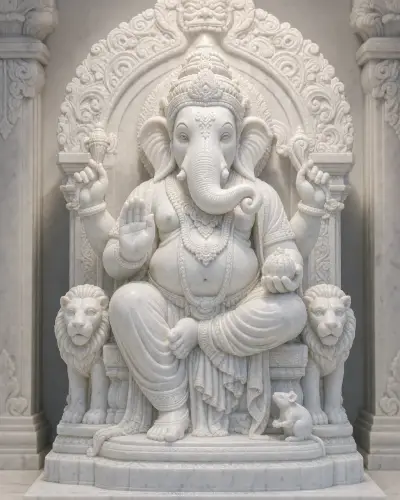
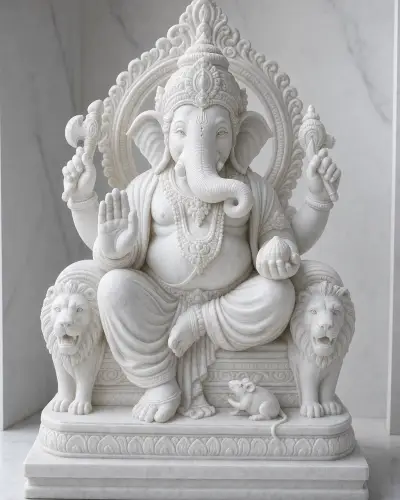
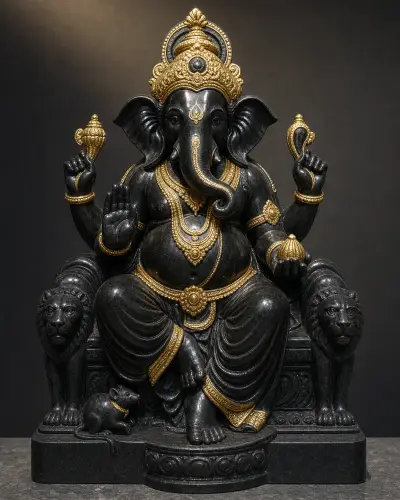
Sagyin White Marble Lalbaugcha Raja with Gold-Leaf Mukut, 18 in
Hand-carved Sagyin white marble Lalbaugcha Raja on a lion-flanked simhasan. An 18-inch apartment shelf murti with a 22k gold-leaf mukut.
Made to order. The pictures here are concept images. This is not a ready item. We get it made for you as per this design, as close as possible, in the size and stone you choose.
Want this design made for you?
Tell us the size, the stone and where it is going. We will send you a quote and a timeline.
Chat on WhatsAppWe'll respond within 5 minutes
About This Piece
The Lalbaug form in Sagyin white marble
The Lalbaugcha Raja is Mumbai's most visited Ganpati. He is the Lalbaug pandal murti that draws queues stretching for kilometres through every Ganeshotsav, known to devotees as Navasacha Ganpati, the fulfiller of vows. This 18-inch interpretation carries the form's defining signature: a lion-flanked simhasan, with carved lions seated at either flank of the throne. The stone is Sagyin White Marble, quarried in the Sagyin Hills near Mandalay in Myanmar and worked for roughly two centuries by the carvers of Kyauk Sit Tan. It reads milky rather than bright: a soft cloudy white with faint grey movement running through the block, which Burmese carvers prize as "movement in the stone" rather than treat as a flaw.
How the mukut is gilded, and the form kept
Work begins in the sculptor's Jaipur workshop with a rough cut that establishes the throne mass and the seated body, followed by primary shaping of the head, the four arms and the potbelly. Sagyin sits slightly softer than Makrana on the Mohs scale, so detail tools bite cleanly, an advantage on the tiered mukut, the throne scrollwork and the lions' manes. Faces, hands, the trunk and the drapery folds are hand-finished throughout; no machine polish touches them. The crown, the necklace bands and the armlets are then gilded in 22k gold leaf, laid by hand over a sealed marble ground and burnished so the leaf sits flush with the carved edge instead of on top of it.
Four arms, as the strict form requires: a modak in one lower hand, the right hand raised in abhaya, the upper pair carrying the ankusha and pasha. The right tusk is broken, the Ekadanta mark tied to the account of Ganesha snapping it to finish writing the Mahabharata, while the left stays intact. The trunk curls to the left, the Vamamukhi orientation that is standard for household worship. His mushak waits at the base of the throne, and the tall layered mukut follows the Lalbaug pandal murti's crown rather than the simpler crowns seen on generic Ganesh murtis.
Where an 18-inch murti fits, and other sizes
At 18 inches the piece is scaled for an apartment: it sits in a pooja unit or on a mandir shelf without needing a dedicated room, and the gold leaf gives it the visual weight of a much larger murti under a warm LED strip. Allow roughly 12 inches of clear width, and keep the throne's back edge a couple of inches off the wall so the carved backrest stays readable. Ganesha is traditionally installed facing north or east; set the shelf at chest height or above so darshan happens at eye level.
The same form is carved from 12 inches up to festival scale, and the gilding can extend across the throne panels or be dropped entirely for a plain white finish. Message us on WhatsApp with your shelf dimensions and we will confirm the proportions before carving begins.
Specifications
Pose
Seated four-armed Lalbaugcha Raja Ganpati on a lion-flanked simhasan throne in warm cloudy-white Sagyin marble, tall mukut finished in 22k gold leaf with gilded necklace edges, trunk curled left, broken right tusk, modak and abhaya blessing, mushak at the base
Color
Cloudy White with Gold Leaf
Finish
Soft polish (satin)
Material
Sagyin White Marble
Ideal For
Apartment pooja unit, Home mandir, Devotional gift
Weight In Kg
24
Depth In Inches
8
Width In Inches
9
Height In Inches
18
Region Or Tradition
Indian / Maharashtrian (Mumbai, Lalbaugcha Raja / Navasacha Ganpati tradition)