Sagyin White Marble Lalbaugcha Raja with Prabhavali Arch, 24 in
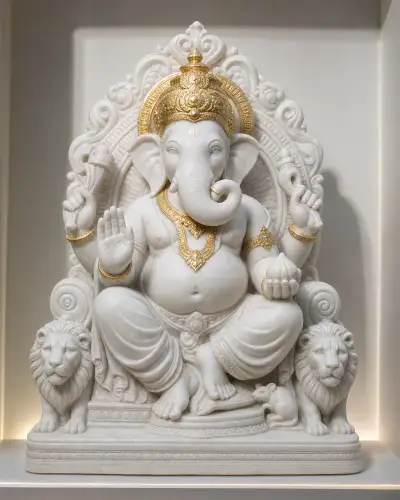
Artisan-carved Sagyin white marble Lalbaugcha Raja on a lion-flanked simhasan: a 24-inch home mandir centrepiece under a prabhavali arch.
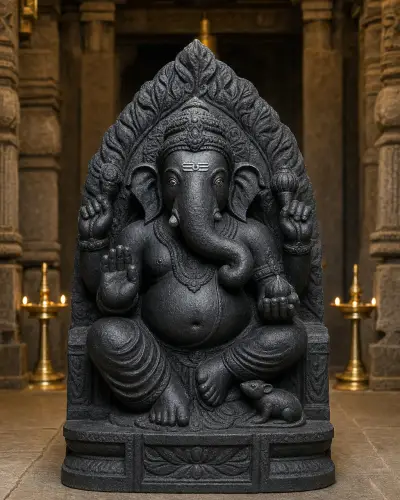
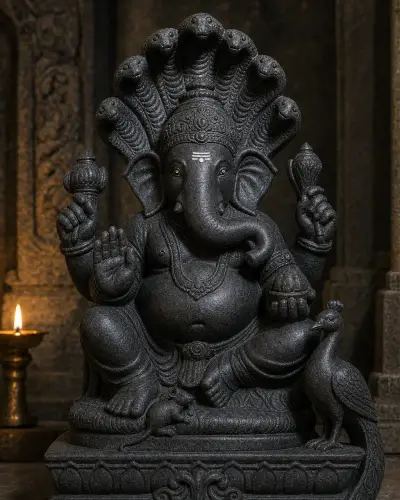
Made to order. The pictures here are concept images. This is not a ready item. We get it made for you as per this design, as close as possible, in the size and stone you choose.
Want this design made for you?
Tell us the size, the stone and where it is going. We will send you a quote and a timeline.
Chat on WhatsAppWe'll respond within 5 minutes
About This Piece
How Sagyin marble differs from Rajasthani stone
Sagyin marble travels a long way to a Jaipur studio. It is quarried in the Sagyin hills north of Mandalay in Myanmar, the same ridge that has supplied Burmese sculptors for generations, and it reads differently from the Rajasthani stones most Ganpati murtis are cut from. It is milky white with a cool bluish undertone rather than a cream warmth, fine and slightly sugary in the grain, with faint grey-green streaks and soft cloudy zones that Burmese carvers call movement in the stone. Light sinks a little way into the surface before coming back, so the crown and the curve of the belly hold a quiet glow instead of a flat white.
How the throne, figure and arch are cut
Carving begins with a rough block squared to the throne's footprint. The independent master sculptors Tilak Mandirwala commissions in Jaipur block out the simhasan, the seated figure and the prabhavali arch as one mass, then work inward to the lion heads at the throne flanks, the torana scrollwork, the layered mukut and the ornaments across the chest. Face, trunk, hands and the folds of the dhoti are finished entirely by hand with chisel and rasp, never machine-dressed, and the surface is brought up through progressive grits to a soft satin polish that keeps the stone's grain readable.
What sets the Lalbaugcha Raja form apart
The form is the Lalbaug one. The Lalbaug Sarvajanik Ganeshotsav Mandal in central Mumbai has installed its Ganpati since 1934, and devotees know it as Navasacha Ganpati, the Ganpati of the vow. What sets that murti apart from other pandal forms is the seat: a simhasan flanked by carved lions, the deity upright and full-frontal beneath an arch rather than settled into a lotus. Four arms carry the ankusha, the pasha, a modak and the raised abhaya of blessing; the trunk turns to the deity's left, and the mushak sits attentive at the plinth.
Setting a 24-inch murti at eye level
At 24 inches the piece works as the centre of a home mandir or a stone-walled prayer alcove rather than as a shelf accent. Allow about 30 inches of clear width so the arch is not crowded, and set it high enough that the seated figure meets the eye of someone standing in front of it. The lion heads and the torana detail only read properly at that height. A single warm downlight from above and in front, as photographed here, is enough; marble does not need much.
Other sizes, stones and gilding options
Sizes from 9 inches to over four feet are made to order, in Sagyin or in Makrana, Vietnam white and black marble. The mukut and ornaments can be gilded in 22k gold leaf, or the whole murti hand-painted in pandal polychrome, and the plinth can carry an engraved family name for a griha pravesh or Ganesh Chaturthi gift.
Specifications
Pose
Seated four-armed Lalbaugcha Raja Ganpati on a lion-flanked simhasan throne beneath a carved prabhavali torana arch, warm cloudy-white Sagyin marble with soft translucency, tall ornate mukut, trunk curled left, broken right tusk, modak and abhaya blessing, mushak at the base
Color
Cloudy White
Finish
Soft polish (satin)
Material
Sagyin White Marble
Ideal For
Home mandir centrepiece, Prayer alcove, Premium devotional gift
Weight In Kg
55
Depth In Inches
12
Width In Inches
16
Height In Inches
24
Region Or Tradition
Indian / Maharashtrian (Mumbai, Lalbaugcha Raja tradition)