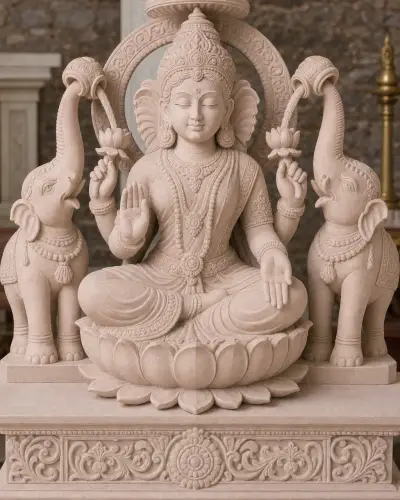
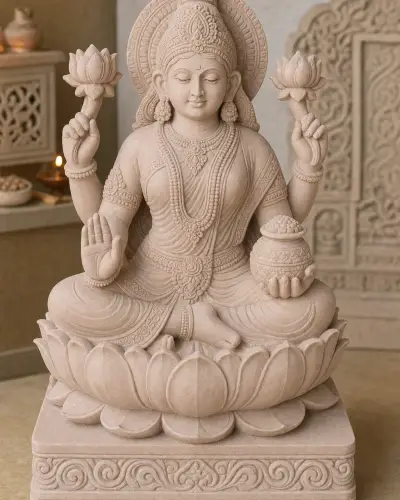
Handcrafted Dholpur Pink Sandstone Lakshmi-Ganesh Pair on Lotus Thrones, 18in
Sculptor-carved Dholpur pink sandstone Lakshmi-Ganesh on lotus thrones. An 18-inch altar pair in warm blush-toned Rajasthani stone.
Made to order. The pictures here are concept images. This is not a ready item. We get it made for you as per this design, as close as possible, in the size and stone you choose.
Want this design made for you?
Tell us the size, the stone and where it is going. We will send you a quote and a timeline.
Chat on WhatsAppWe'll respond within 5 minutes
About This Piece
The Dholpur pink sandstone
Dholpur sandstone comes out of the quarry belt in eastern Rajasthan, along the Chambal, and it has been worked by North Indian builders since the Mughal period. It is the same stone family that faced the forts and gateways of Agra and Dholpur. The pale blush-pink variant used here is the softer, warmer cousin of the familiar red: a fine quartz sandstone with an even sandy grain, faint sedimentary banding, and the occasional iron-oxide freckle. Against the white marble that dominates most Lakshmi-Ganesh pairs, it reads warm rather than cool, closer to kumkum than to snow.
How the pair is carved and honed
The pair is carved to order by the independent master sculptors Tilak Mandirwala has worked with in Jaipur for years. Each figure starts as a rough block, is brought to primary mass with point and pitching chisels, then detailed entirely by hand: the crowns, the layered necklaces, the fold of Lakshmi's sari, the ridged texture of Ganesh's ears. Sandstone is more forgiving than marble under the chisel but far less forgiving of a slip, so faces, hands, and ornament are always hand-finished rather than machined. The surface is taken to a matte honed finish; sandstone's natural porosity means it will never mirror-polish, and it is not meant to.
Lakshmi and Ganesh on their lotus thrones
Lakshmi sits on Ganesh's right, as she does in the Diwali and Dhanteras pairing across North India. Both are four-armed and seated in padmasana on their own lotus thrones, raised on a shared carved plinth. Lakshmi holds lotuses in her upper hands and a kalash in her lower right, turning the lower left outward in the giving gesture. Ganesh carries a bowl of modaks and raises his right palm in abhaya, his trunk curled to the left in the auspicious form, with the mouse vahana resting at the foot of his throne.
Where the 18-inch pair sits, and other options
At 18 inches the pair reads as the main murti of a home altar rather than a shelf accent. It wants a niche or chowki roughly two feet wide, with clear space above the crowns. The warm stone sits well against cream lime plaster, terracotta tile, or teak, and takes to diya light better than a polished white piece does: the matte surface scatters the flame instead of throwing hard highlights. For households that keep the altar dressed year-round, the tone stays comfortable in plain daylight too.
The same pair can be carved at 12 or 24 inches, set on a single shared lotus base instead of separate thrones, or worked in Makrana white marble or black granite if the warm stone is not the fit. A family name can be cut into the plinth face for housewarming gifting. Message us to talk through stone samples and dimensions.
Specifications
Pose
Seated Padmasana on individual lotus thrones, side by side on a shared carved plinth, four-armed forms with canonical attributes (Lakshmi with lotuses and kalash; Ganesh with modak bowl, abhaya mudra and left-curled trunk, mouse vahana at the base)
Color
Pink
Finish
Matte (honed)
Material
Dholpur Pink Sandstone
Ideal For
Distinctive home altar, Diwali pooja with warm-tone aesthetic, Housewarming gift
Weight In Kg
16
Depth In Inches
9
Width In Inches
20
Height In Inches
18
Region Or Tradition
Indian / Rajasthani (Dholpur sandstone, North Indian Diwali tradition)