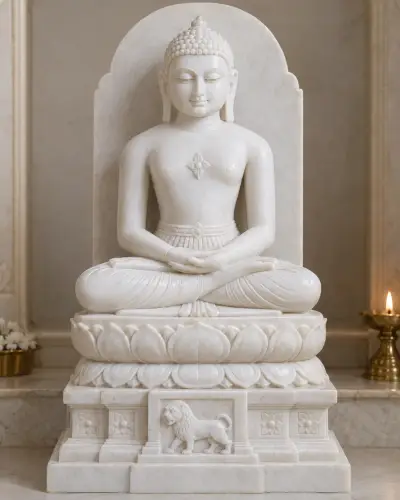
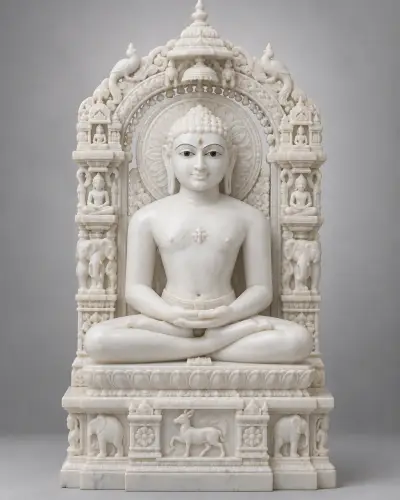
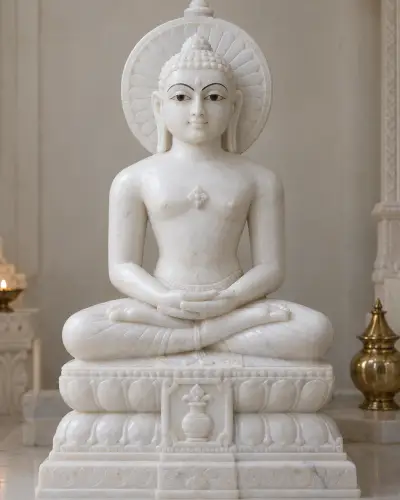
Makrana White Marble Gautam Swami Murti, 15in
Sculptor-carved Makrana white marble Gautam Swami murti, 15 inches, standing with the rajoharan, right hand raised in blessing.
Made to order. The pictures here are concept images. This is not a ready item. We get it made for you as per this design, as close as possible, in the size and stone you choose.
Want this design made for you?
Tell us the size, the stone and where it is going. We will send you a quote and a timeline.
Chat on WhatsAppWe'll respond within 5 minutes
About This Piece
Who this murti is
Gautam Swami is Indrabhuti Gautam, the Brahmin scholar from near Nalanda who came to Bhagwan Mahavira's samavasaran at Madhyama Pava to argue with him and left as his disciple. He became the first and chief of the eleven ganadhars, the one who put Mahavira's teaching into the words the Jain canon still carries. Tradition holds that he attained kevalgyan on the night Mahavira reached nirvana, which is why Jain households turn to him on the morning after Diwali, and why Gujarati families open new account books on Labh Pancham with an invocation to his labdhi at the head of the first page. For a great many derasars he is the murti that stands beside the Tirthankara, not behind him.
A ganadhar, not a Tirthankara
Everything about the way this piece is carved says monk rather than Jina, and the distinction is the whole point of the form. He stands upright, clothed: the monastic cloth is drawn over the left shoulder and across the chest, with the lower garment falling to the ankles in deep worked folds. There is no srivatsa on the chest, no lanchhana on the pedestal, no crown and no ornament, because none of those belong to a ganadhar. What names him instead is the rajoharan: the soft woollen whisk on a short handle, hanging from the lowered left hand, the implement a Shvetambar sadhu uses to sweep a seat clear before he takes it. The right hand is raised palm-outward in blessing, and the head is shaven clean, without the ushnisha that would pull the figure toward a Buddha.
Makrana marble, and the carving
The stone is Makrana, quarried in Rajasthan's Nagaur district, a few hours by road from Jaipur, and best known as the marble of the Taj Mahal. It is dense and close-grained, which is what a standing figure at this scale needs: the drapery is the carving here, and a coarser stone loses its edge where the folds undercut. We draw the murti with you and stay with it through to installation; the cutting is done by the master sculptors we work with in Jaipur. A squared block is roughed to the standing silhouette, the lotus plinth is blocked in, and detail begins only once the proportion reads correctly from the front. The face, the raised palm, the fingers closed on the rajoharan handle and the whisk itself are cut by hand throughout, with no machine going near them, and the piece is then taken up through progressively finer abrasives to a soft satin polish that holds light rather than glaring it back.
A 15-inch murti in a home derasar
Fifteen inches is comfortable domestic scale. It reads properly from six or eight feet, one person can lift and bathe it, and it sits beside a larger mulnayak without competing for the eye. Allow about a foot of clear shelf width and eight inches of depth so the lotus plinth is not crowded. Set it high enough that a seated devotee looks slightly up at the face, and keep the wall behind it plain, because a patterned backdrop breaks up the drapery, which is where most of the carving is. A single diya to one side lights the folds better than an overhead lamp, which flattens them.
Commissioning yours
Every part of this can change. The same Gautam Swami can be cut taller for a community derasar, carved in Vietnam white or black stone instead of Makrana, given a taller stepped pedestal, or made as a pair with a standing Sudharma Swami. Tell us the height of your shrine and the date you would like to do the pratishtha and we will work back from it: a murti at this size takes eight to twelve weeks from the day the drawing is approved, before crating and transit.
Specifications
Pose
Standing ganadhar in full Shvetambar monastic attire with the monastic cloth drawn over the left shoulder and across the chest, rajoharan whisk in the lowered left hand, right hand raised palm-outward in blessing, shaven head, no srivatsa and no lanchhana, feet together on a plain lotus plinth
Color
White
Finish
Soft polish (satin)
Material
Makrana White Marble
Ideal For
Home derasar, Derasar
Weight In Kg
7
Depth In Inches
6
Width In Inches
6
Height In Inches
15
Region Or Tradition
Indian / Jain (Shvetambar Murtipujak derasar tradition)