Makrana White Marble Jain Derasar with Backlit Jali Panels — 48 in
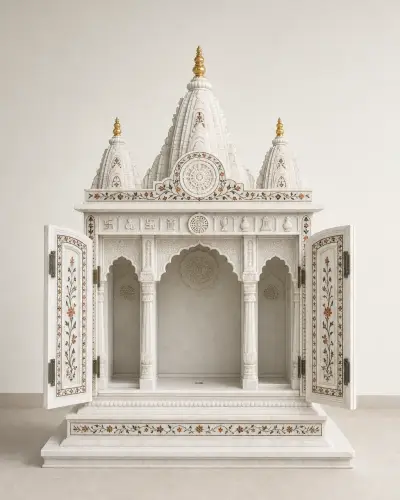
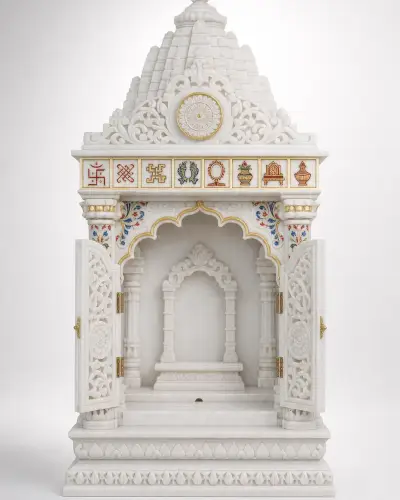
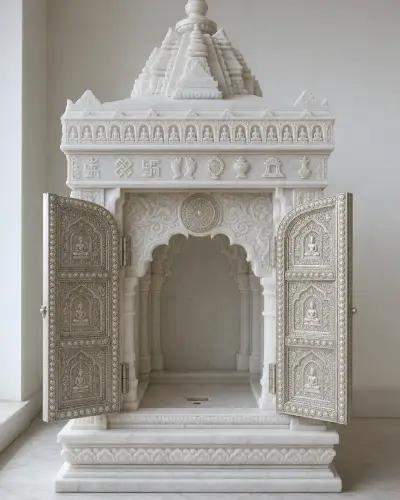
Floor-standing Makrana marble Jain derasar, 48 inches, with pierced jali side walls and a backlit rear screen that glows through the ashtamangal roundels.
Made to order. The pictures here are concept images. This is not a ready item. We get it made for you as per this design, as close as possible, in the size and stone you choose.
Want this design made for you?
Tell us the size, the stone and where it is going. We will send you a quote and a timeline.
Chat on WhatsAppWe'll respond within 5 minutes
About This Piece
Marble that will hold a pierced screen
A jali wall asks more of a stone than a solid panel ever does. Once the lattice is drilled and chiselled through, what is left carrying the load is a grid of ribs a few millimetres across, and a stone with coarse crystal or a hidden seam will spall at the first corner. Makrana marble is chosen here for exactly that reason: it is a dense calcitic marble from the quarries north-west of Jaipur, tight-grained and low in porosity, and it takes a fine drilled perforation without chipping at the exit face. It is the same material the Dilwara temples at Mount Abu were worked in, where the ceilings were cut so thin they read as translucent. The tone is a bright natural white with a faint cream warmth, and it is left honed here rather than mirror-polished, because a matte surface scatters the lamp instead of flaring it back at the eye.
What the backlight is actually doing
The two side walls and the rear panel of this derasar are cut right through, so the sanctum is enclosed by screen rather than by slab. A low, warm light source sits behind the rear panel, outside the gabhara, and the lattice turns it into a field of small points instead of a glare. Two things follow. The white marble reads as luminous from the front rather than lit from above, which keeps the murti's face in soft even light with no hard shadow under the brow. And the ashtamangal roundels set into the jali pattern go dark against the glow, so at aarti the symbols read as silhouette and throw their own pattern onto the wall behind the shrine as the lamp moves. The lighting is an ordinary warm LED strip on a dimmer; nothing is wired into the stone.
The sanctum, the doors, and the water
Under the ornament this is a working shrine, built to the Gujarati Shvetambar Murtipujak pattern. The gabhara closes behind two hinged carved doors, shown here standing open on their pins, each panel carrying its own jali field so the piece is ornament whether it is open for darshan or shut overnight. The sanctum floor is cut with a shallow prakshal channel that falls to an outlet at the front lip, so the morning ablution drains clear instead of standing against the pedestal. It is the single detail that most decides whether a marble shrine still looks new after ten years of daily use. The shikhar above rises in a stepped spire to an amalaka, a kalash and a dhwaja, and the whole shrine stands on a high stepped plinth with a carved floral band, which lifts the sanctum to a seated devotee's eye line without a separate table.
An entirely Jain symbol program
Nothing on this piece is borrowed from another tradition. A carved frieze of the eight ashtamangal runs the full width of the lintel: the swastika with its three dots and the crescent siddhashila above it, the shrivatsa, the nandyavarta, the paired fish, the mirror, the water-pot, the throne and the powder-vase. A circular siddhachakra medallion is carved above the door arch. The same eight symbols reappear as roundels worked into the jali, which is what makes the screen legible rather than merely decorative. There is no Ganesh at the threshold, no Om, no trishul, no conch-and-discus and no Nandi anywhere on the shrine, and no Hindu figure is carved into the panels. For a family installing in a home where the derasar is the only shrine, that consistency is usually the point.
Sizing it, and changing it
At 48 inches tall and about 26 inches across the plinth, this stands on the floor as a derasar rather than sitting on a cabinet, and it suits a dedicated pooja room or a finished basement shrine room where a clear foot on each side lets the doors swing fully open. The stone runs to roughly 95 kg, so it wants a solid floor rather than a raised wooden platform. Every part of it is drawn to the commission: the gokhla can be widened to a particular mulnayak murti, the jali pattern taken denser or more open, the shikhar simplified, a lock specified on the doors, and a family name or pratishtha date engraved into the plinth. A shrine of this scale usually runs eight to twelve weeks with the Jaipur sculptors before crating. Send the alcove dimensions and the height of the murti going in, and the plan is drawn around them.
Specifications
Pose
Floor-standing single-sanctum derasar — pierced jali lattice cut through both side walls and the rear panel with ashtamangal roundels worked into the pattern, a backlit sanctum screen, two hinged carved doors on the gabhara, a carved siddhachakra medallion and ashtamangal frieze across the lintel, and a stepped shikhar spire with amalaka, kalash and dhwaja on a high stepped plinth
Color
Natural White
Finish
Matte (honed)
Material
Makrana White Marble
Ideal For
Dedicated pooja room, Finished basement shrine room, Evening aarti
Decoration
jali_lattice
Weight In Kg
95
Depth In Inches
18
Width In Inches
26
Height In Inches
48
Decoration Detail
Pierced jali lattice cut right through the side walls, rear panel and door leaves, with the eight ashtamangal symbols set as roundels in the screen and a carved siddhachakra medallion above the door arch; lit from behind the rear screen
Region Or Tradition
Indian / Gujarati (Shvetambar Murtipujak ghar derasar tradition)