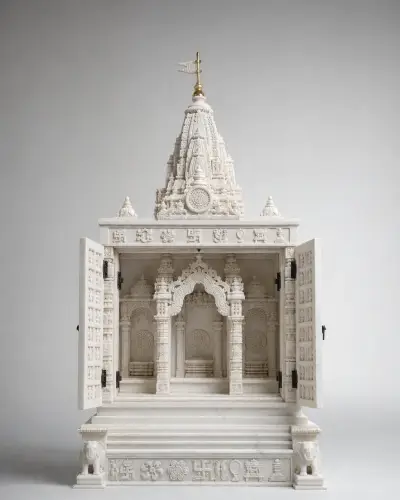
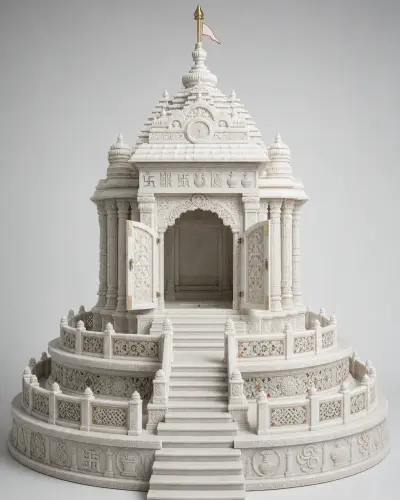
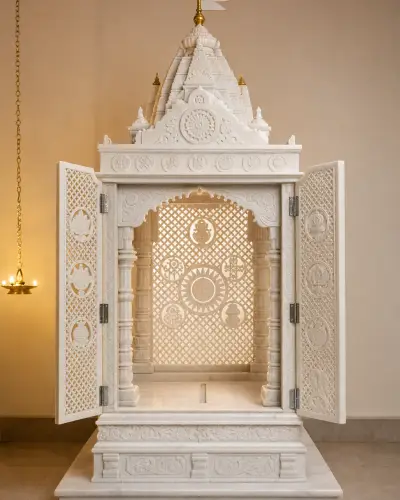
Makrana White Marble Jain Derasar, Silver-Clad Doors with Chovis Tirthankar Frieze — 42 in
Makrana white marble Jain derasar, 42 inches, with repoussé silver-clad doors and a chovis frieze of all twenty-four Tirthankars across the lintel.
Made to order. The pictures here are concept images. This is not a ready item. We get it made for you as per this design, as close as possible, in the size and stone you choose.
Want this design made for you?
Tell us the size, the stone and where it is going. We will send you a quote and a timeline.
Chat on WhatsAppWe'll respond within 5 minutes
About This Piece
Silver over stone, and how the two are joined
The shrine is carved from Makrana white marble, the dense Rajasthani stone that has been cut for temple work since the Mughal ateliers and still holds an undercut edge without crumbling. It is left honed rather than mirror-polished, and that choice is doing real work here: a matte white ground throws no competing highlight, so the only thing on the piece that catches light is the silver. The door leaves are clad in repoussé sheet, the pattern raised from behind with punches until each arched compartment and every bead of the border stands proud, then chased from the front. That sheet is raised by a silversmith working from the same drawing as the carver, and fitted over the finished marble leaves on their hinges; the stone is the piece and the metal is its facing, not the other way round. White marble and white metal sit together without arguing, which is why the combination has stayed in Jain shrine work for generations.
Twenty-four above three
Across the full width of the lintel runs a chovis frieze: all twenty-four Tirthankars of this avasarpini, carved in low relief, each seated padmasana in a small arched compartment of his own. It is a deliberate idea rather than decoration. A family installs one mulnayak and perhaps two attendant murtis in the gokhla below; the frieze puts the entire lineage above them, so that the three being worshipped are read against the twenty-four they belong to. Beneath it, on a second band, crosses the ashtamangal (the swastika with its three dots and the crescent siddhashila over it, the shrivatsa, the nandyavarta, the paired fish, the mirror, the water-pot, the throne and the powder-vase), and a circular siddhachakra medallion is set into the face of the arch above the doorway. Nothing is borrowed from another tradition: no Ganesh at the threshold, no Om, no trishul, no conch-and-discus, no Nandi.
What happens behind the door leaves
The gabhara closes properly. Two hinged leaves swing on visible pin hinges and are shown standing open here, so the silver is ornament whether the shrine is open for darshan or shut overnight. Inside, slender carved pillars divide the sanctum into three gokhla bays, the central one taller, which is what lets a household install a mulnayak flanked by two smaller murtis without any of them looking crowded. The sanctum floor is cut with a shallow prakshal channel falling to an outlet at the front lip, so the morning ablution drains clear instead of standing against the pedestals. It is the detail most often left out, and the reason so many shrines are water-stained inside a few years. The back wall is kept plain on purpose: a carved backdrop competes with the murtis, while a quiet one sets them off.
Forty-two inches in a room that is already furnished
At forty-two inches tall, roughly twenty-four across the plinth and fifteen deep, this stands as its own object rather than sitting on furniture. It runs to about seventy-five kilos, so it wants a floor or a low masonry platform rather than a wooden cabinet, and it arrives on a lotus-carved stepped base that lifts the sanctum to a comfortable standing darshan height for an adult. Allow about a foot clear on each side for the leaves to open fully, and keep a warm lamp off to one side rather than straight overhead, since Makrana takes a faint cream cast under a low-CRI downlight. It is a size that suits a dedicated pooja room in a bungalow or a larger apartment, and it is the size Jain families abroad most often ask for when a shrine has to serve a household in a room of its own.
What a donor commission usually changes
Very little about a derasar is standardised, and this one is drawn to the murtis going into it. The gokhla are sized to the mulnayak rather than the murti being chosen to fit; the silver can be taken further across the door surrounds, reduced to beading alone, or dropped for plain carved marble; the shikhar can be raised or flattened to suit a ceiling; a lock can be fitted. Donor pieces for a sangh or a centre are frequently engraved on the plinth with a family name and the pratishtha date, and that lettering is cut into the stone at the workshop rather than applied afterwards. The carving is done by the Jaipur sculptors we work with and generally takes eight to twelve weeks before crating, with the silver work running alongside it. It ships worldwide in a braced wooden case. Send the sanctum height you need and the murti dimensions, and the drawing starts there.
Specifications
Pose
Shikharbandhi ghar derasar with a single gabhara divided into three gokhla bays by slender carved pillars, closed by two hinged repoussé silver-clad door leaves shown standing open, a chovis frieze of all twenty-four Tirthankars in arched compartments across the full lintel, an ashtamangal band below it and a carved siddhachakra medallion in the arch face, a shallow prakshal drainage channel in the sanctum floor, and a lotus-carved stepped plinth beneath a shikhar top with kalash finial
Color
Natural White
Finish
Matte (honed)
Material
Makrana White Marble
Ideal For
Family ghar derasar, Sangh or center side-shrine, Donor family commission
Decoration
silver_leaf
Weight In Kg
75
Depth In Inches
15
Width In Inches
24
Height In Inches
42
Decoration Detail
Repoussé silver sheet cladding raised and chased by a silversmith, fitted over the two carved door leaves with silver beading to the door surrounds; the marble is left honed so the metal carries the only highlight on the piece
Companion Elements
Repoussé silver sheet door cladding, Metal pin hinges
Region Or Tradition
Indian / Gujarati (Shvetambar Murtipujak derasar tradition)