Makrana White Marble Jain Samavsaran Derasar — 54 in
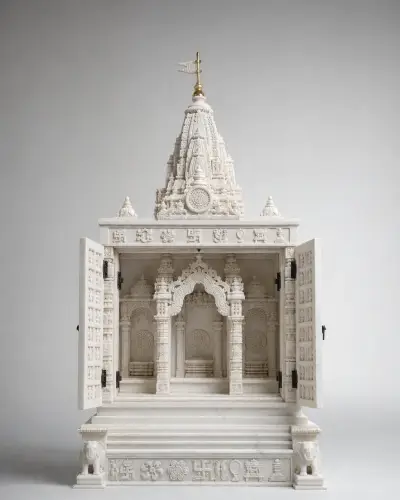
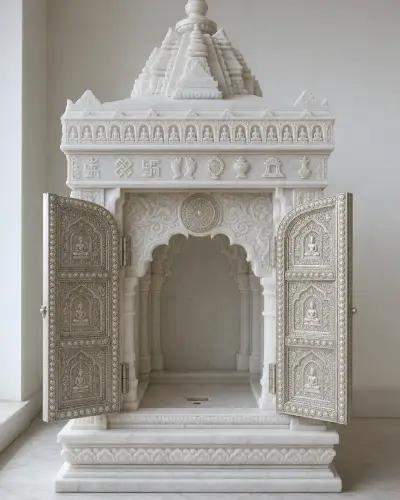
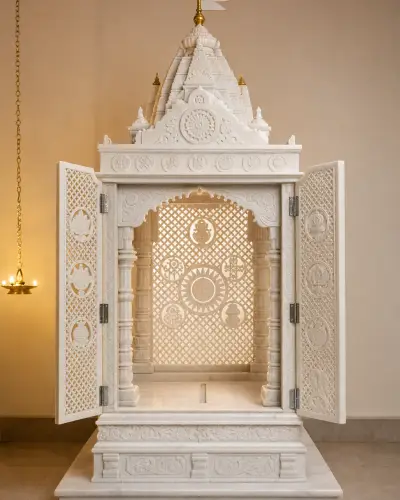
Makrana white marble Jain derasar on the samavsaran plan. 54 inches, three inlaid tiers rising to a gabhara with open carved doors.
Made to order. The pictures here are concept images. This is not a ready item. We get it made for you as per this design, as close as possible, in the size and stone you choose.
Want this design made for you?
Tell us the size, the stone and where it is going. We will send you a quote and a timeline.
Chat on WhatsAppWe'll respond within 5 minutes
About This Piece
The samavsaran, and why this form could not be anything else
Every other shrine in this range is a building, with a sanctum, a spire and a doorway. This one is an event. The samavsaran is the preaching assembly the devas are said to raise the moment a Tirthankar attains kevalgyan: concentric tiered ramparts climbed by stepped approaches, with the Jina at the centre so that the whole gathering hears the first sermon at once. It belongs to Jain tradition and to nothing else. A Hindu mandir has no counterpart to it, and that is the practical argument for choosing this plan over a shikharbandhi shrine: a derasar built on the samavsaran announces what it is from across a room, before anyone has read a single symbol carved on it. For a sangh hall or a donor commission, that legibility is usually the whole point.
Three concentric tiers rise here, each ringed by its own balustrade and each set back from the one below, so the ascent reads as an ascent rather than as moulding on a plinth. A single flight climbs the front face to the gabhara at the summit. The circular plan is what makes the piece difficult: every course has to be cut on a curve, every balustrade post has to sit true on a radius, and the steps have to land square on a round tier. It is carved in courses at the workshop and assembled on site, which is how marble work of this size has always been done.
What is carried on each tier
The lowest drum is the symbol register. Ashtamangal are cut into it in raised roundels between slender engaged pilasters (the swastika with its three dots and the crescent siddhashila above, the shrivatsa, the nandyavarta, the paired fish, the mirror, the water-pot, the throne and the powder-vase), so that the eight are read at eye level by anyone standing in front of the shrine, before the eye travels up. Above it the two upper tiers carry the balustrades, and those alternate two treatments: pierced jali panels cut through the stone, and solid panels set with coloured inlay. Turned finials cap every post. The alternation is deliberate rather than decorative variety. A run of unbroken jali at this diameter starts to look like lacework and loses the weight a shrine wants, while a run of unbroken inlay turns the tier into a stripe of colour.
The gabhara at the summit
The sanctum closes properly. Two carved leaves swing on visible pin hinges and are shown here standing open, which is how a derasar is kept through the day and shut overnight. Across the lintel runs a second ashtamangal frieze, and a circular siddhachakra medallion is set into the face of the arch above the doorway. A toran arch frames the opening. The sanctum floor is cut with a shallow prakshal channel falling to an outlet at the front lip, so the morning ablution drains clear of the pedestal instead of standing against it. The symbol program is strictly Jain throughout: no Ganesh at the threshold, no Om, no trishul, no conch-and-discus, no Nandi, nothing borrowed from a neighbouring tradition and carved in by habit. The gokhla is left open and unsized in the drawing so that it can be cut to the mulnayak a family or a trust already has, rather than the murti being chosen afterwards to fit a standard opening.
Where the colour is allowed to go
The inlay is parchin kari, the Jaipur descendant of the Mughal pietra dura trade. Cavities are ground into the marble to the exact profile of each petal and leaf, and slips of coloured stone are cut, bevelled and bedded into them so the finished surface comes back flush under the hand. The palette is stone, not paint: malachite greens, lapis and jasper blues, carnelian and red jasper for the flowers. It is confined to the balustrade panels alone. That restraint is doing real work. The marble is left honed rather than mirror-polished, a matte white ground throws no competing highlight, and the colour therefore reads as a narrow ribbon travelling around each tier instead of a pattern spread over the whole shrine. Look at it from ten feet and you see white stone with three bands of colour climbing it; step close and each band resolves into individual flowers.
Fifty-four inches, and what a trust commission usually changes
At fifty-four inches tall on a base of roughly thirty-six inches across, this is a floor piece, and a substantial one: around one hundred and eighty-five kilos across its courses. It wants a floor or a low masonry platform rather than a wooden cabinet, and the tiers are stacked and bedded on site rather than arriving as a single block. Allow clear space on the front face for the steps and about a foot at the sides for the doors to open fully. Keep a warm lamp off to one side rather than directly overhead: Makrana takes a faint cream cast under a low-CRI downlight, and the inlay colours read truest in daylight or a high-CRI warm-white.
Very little about a derasar is standardised. The number of tiers can be reduced to two for a lower ceiling or taken to four where there is height; the stepped approach can be cut on all four faces in the fuller samavsaran manner rather than on the front alone; the inlay can be extended into the lowest drum or dropped for plain carved marble; the shikhar can be raised or flattened. Donor pieces for a sangh or a centre are commonly engraved on the base course with a family name and the pratishtha date, and that lettering is cut into the stone at the workshop rather than applied later. Carving is done by the Jaipur sculptors we work with and generally runs eight to twelve weeks before crating, with the inlay work proceeding alongside it. It ships worldwide in braced wooden cases. Send the sanctum height you need and the dimensions of the murti going into it, and the drawing starts there.
Specifications
Pose
Samavsaran-form derasar — three concentric tiered circular platforms with carved balustrades alternating pierced jali and coloured-stone inlay panels, a stepped approach climbing the front face, an ashtamangal roundel register around the lowest drum, and the gabhara at the summit closed by two hinged carved doors shown standing open, with a toran arch, a second ashtamangal frieze on the lintel, a siddhachakra medallion in the arch face, a shallow prakshal drainage channel in the sanctum floor, and kalash and dhwaja above the shikhar
Color
Natural White
Finish
Matte (honed)
Material
Makrana White Marble
Ideal For
Jain center or sangh, Large home shrine room, Trust commission
Decoration
stone_inlay
Weight In Kg
185
Depth In Inches
36
Width In Inches
36
Height In Inches
54
Decoration Detail
Parchin kari inlay — coloured stone slips (malachite, lapis, jasper, carnelian) cut and bedded flush into cavities ground in the marble, confined to the balustrade panels of the two upper tiers so the colour reads as a band around each tier against the honed white ground
Region Or Tradition
Indian / Gujarati (Shvetambar Murtipujak derasar tradition)