Makrana White Marble Jain Mulnayak Derasar with Parikar Framing — 60 in
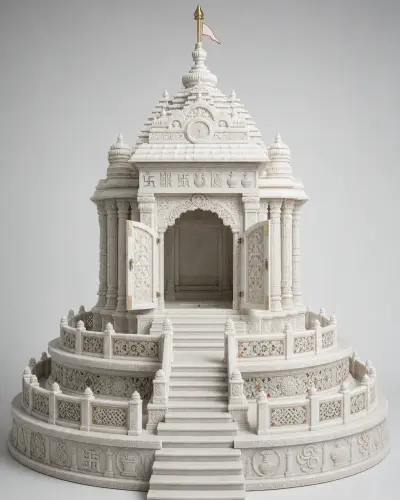
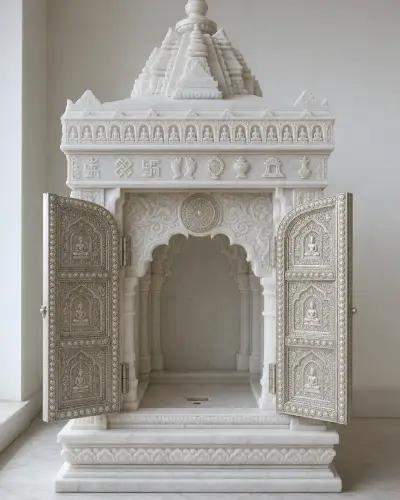
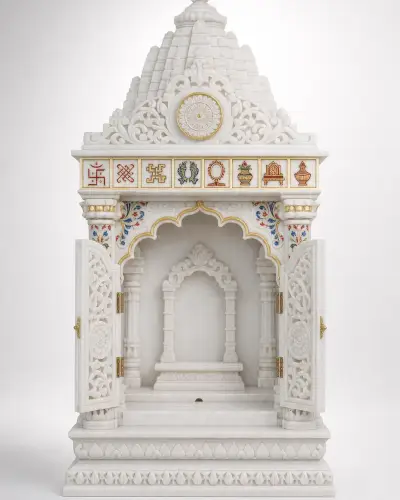
Trust-scale Makrana marble Jain derasar, 60 inches, three gokhla with a full carved parikar over the mulnayak and elephants at the base.
Made to order. The pictures here are concept images. This is not a ready item. We get it made for you as per this design, as close as possible, in the size and stone you choose.
Want this design made for you?
Tell us the size, the stone and where it is going. We will send you a quote and a timeline.
Chat on WhatsAppWe'll respond within 5 minutes
About This Piece
What a mulnayak derasar is, and why the parikar matters
A derasar is named for its mulnayak, the principal Tirthankar the shrine is built around: the murti a sangh or a family consecrates at the centre and orients the whole plan toward. This 60-inch Makrana white marble derasar is built on that logic. The principal gokhla is not simply the largest of three openings; it is carried in a full carved parikar, the architectural surround that marks a murti as the mulnayak rather than an attendant image. Flanking pilasters hold miniature Tirthankar compartments, a makara toran arch springs across the opening and is closed above by a tiered chhatra, and a lotus-medallion bhamandala is cut into the rear wall behind where the murti will sit. Take the parikar away and the same three niches read as a cabinet. Carve it, and the shrine states its hierarchy before anyone has looked inside.
The three gokhla and the sanctum doors
Three gokhla open across the front of this Jain derasar: the mulnayak at the centre and a flanking niche on either side, each with its own pillared frame and rear medallion, so a trust can seat a principal Tirthankar with two attendant murtis without crowding them. The gabhara closes properly. Two carved leaves swing on visible pin hinges and are shown standing open, which is how a derasar is kept through the day and shut overnight. Across the lintel runs a frieze of the eight ashtamangal: the swastika with its three dots and the crescent siddhashila above it, the shrivatsa, the nandyavarta, the paired fish, the mirror, the water-pot, the throne and the powder-vase. A circular siddhachakra medallion is set above the door arch. The sanctum floor is cut with a shallow prakshal channel falling to the front lip, so the morning ablution drains clear of the pedestal instead of standing against it.
Makrana, and why the carving is left plain
The stone is Makrana, quarried in Nagaur district in Rajasthan and the marble Jain builders have used for sanctum work since long before the Mughals took it to Agra: dense, low-porosity and slow to yellow, which is why it survives daily prakshal where softer white marbles pit. It is left honed here rather than mirror-polished. That is a deliberate choice on a shrine carved this heavily. A gloss surface throws highlights that fight the relief, while a matte white ground lets the shadow in each cut do the describing. There is no inlay, no gold leaf and no paint anywhere on it. Every ornament is cut from the marble itself: the ashtamangal roundels on the plinth course, the elephants at the base corners, the pierced door leaves, the ribbed shikhar and the kalash and dhwaja above it. The whole ornamental program is carving, and at trust scale that reads as seriousness rather than restraint.
Sixty inches on a plinth, and installing it
At sixty inches tall, roughly thirty-six across and twenty-four deep, this is a floor-standing shrine of about one hundred and sixty-five kilos, meant to stand on its own high stepped platform rather than on a cabinet or a table. That platform is part of the design: it lifts the mulnayak to standing eye level for darshan, carries the lower ashtamangal course, and puts the carved elephants at the corners where a plinth is actually read from. Give it a masonry floor or a slab that will take the load, allow about a foot clear on each side so the doors swing fully open, and leave three or four feet in front for the pratishtha rites. Light it from the sides with a high-CRI warm white rather than from directly overhead. Makrana picks up a faint cream cast under a low-CRI downlight, and a single hard overhead source flattens the relief the shrine is carved for.
What a trust commission usually changes
Very little about a derasar is standardised, and a piece at this scale is almost always drawn to one specific sanctum. The gokhla openings are cut to the murtis a family or a trust already has, rather than the murtis being chosen afterwards to fit a standard niche, so the mulnayak's height and the pedestal depth are the first two dimensions to send. The shikhar can be raised or flattened for a low ceiling, the three gokhla reduced to one or extended to five, and the parikar simplified where a plainer sanctum is wanted. Donor pieces for a sangh or a Jain centre are commonly engraved on the plinth course with a family name and the pratishtha date, cut into the stone at the workshop rather than applied afterwards. Carving is done by the Jaipur sculptors we work with and generally runs eight to twelve weeks before crating; it ships worldwide in braced wooden cases, in numbered sections at this size.
Specifications
Pose
Trust-scale mulnayak derasar — three gokhla niches with the principal gokhla carried in a full carved parikar: flanking pilasters holding miniature Tirthankar compartments, a makara toran arch closed above by a tiered chhatra, and a lotus-medallion bhamandala in the rear wall behind the murti position; a high stepped platform with carved elephants at the base corners, an ashtamangal roundel course across the plinth, two hinged carved gabhara doors shown standing open with a shallow prakshal drainage channel in the sanctum floor, an ashtamangal frieze across the lintel, a siddhachakra medallion above the door arch, and a tall ribbed shikhar with kalash and dhwaja
Color
Natural White
Finish
Matte (honed)
Material
Makrana White Marble
Ideal For
Jain center or sangh derasar sanctum, Community installation, Trust or donor family commission
Decoration
plain_carved
Weight In Kg
165
Depth In Inches
24
Width In Inches
36
Height In Inches
60
Decoration Detail
Carved marble throughout, no inlay, gilding or paint — a makara toran arch and tiered chhatra over the mulnayak gokhla, lotus-medallion bhamandala panels, ashtamangal friezes on both the lintel and the plinth course, a siddhachakra medallion above the door arch, pierced door leaves and elephants at the base corners
Region Or Tradition
Indian / Gujarati (Shvetambar Murtipujak derasar tradition)