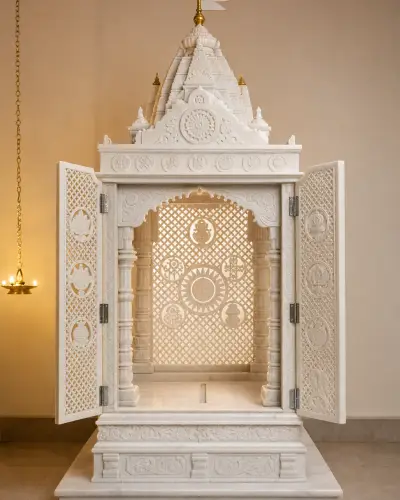
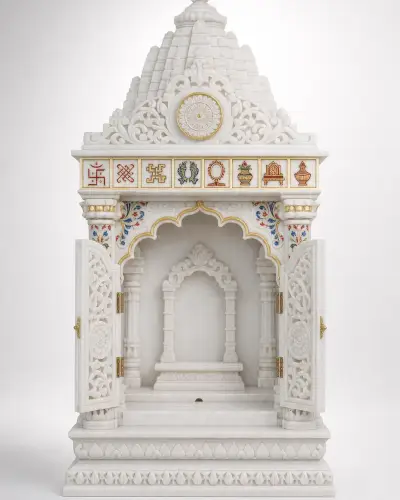
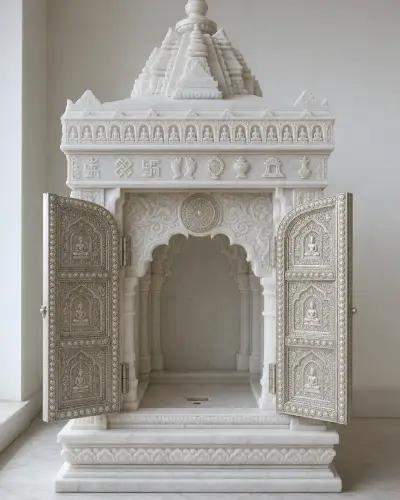
Makrana White Marble Jain Derasar, Three Gokhla with Parchin Kari Inlay — 36 in
Master-carved Makrana marble Jain ghar derasar: a 36-inch three-gokhla shrine with parchin kari inlay and a carved ashtamangal lintel.
Made to order. The pictures here are concept images. This is not a ready item. We get it made for you as per this design, as close as possible, in the size and stone you choose.
Want this design made for you?
Tell us the size, the stone and where it is going. We will send you a quote and a timeline.
Chat on WhatsAppWe'll respond within 5 minutes
About This Piece
Makrana marble, and why a derasar is carved from it
Makrana is the stone the Jain temple tradition has leaned on for six centuries, from the same quarries north-west of Jaipur that supplied the Dilwara group at Mount Abu and, later, the Taj Mahal. It is a dense calcitic marble with a fine, lightly sugary crystal, and the two qualities that matter to a ghar derasar are hardness and stability. Hardness is what lets a sculptor cut the undercut foliage of a cusped arch and the thin ribs of a shikhar spire without the stone crumbling at the edge. Stability is what keeps a 36-inch shrine true through decades of daily abhishek and prakshal water. The tone is a bright natural white with only the faintest cream warmth, honed to a soft matte here rather than mirror-polished, so the carving reads through shadow instead of disappearing into glare.
The three-gokhla plan
Three niches is the canonical family derasar layout: a wide mulnayak gokhla at the middle, where the principal Tirthankar is installed, flanked by two narrower gokhla for the attendant murtis. Nothing about the plan is decorative. It is how a Shvetambar Murtipujak household actually installs, and it is why a family that already owns three murtis has nowhere to put them in a single-niche mandir. The gabhara closes behind two hinged carved doors on brass pins, shown here standing open. Each door panel carries its own inlay field, so the shrine reads as ornament whether it is open for darshan or closed overnight. A shallow prakshal channel is cut into the sanctum floor and falls to a small outlet, so the morning ablution drains instead of pooling against the murti's pedestal.
The inlay and the symbol program
The coloured-stone work is parchin kari, the Agra and Jaipur pietra dura tradition in which lapis, carnelian, malachite and jasper are cut to shape and set flush into channels chiselled out of the marble, not painted on. It runs the door panels, the arch spandrels and a continuous band across the stepped plinth, in a restrained floral vine rather than a dense field, so it lifts the white without competing with it. Above the doors the lintel carries a carved frieze of the ashtamangal (the swastika with its three dots and crescent siddhashila, the shrivatsa, the nandyavarta, the paired fish, the mirror, the water-pot, the throne and the powder-vase), and a circular siddhachakra medallion sits at the centre. The iconography is strictly Jain throughout; there is no Hindu figure, emblem or vahana anywhere on the piece.
Installing it in a pooja room
At 36 inches tall and roughly 24 inches wide the shrine reads as a proper derasar rather than a cabinet-top mandir, and it wants a dedicated pooja room or a deep alcove. Allow a clear foot on each side so the doors swing fully open and the side gokhla stay visible. It is best set on its own low wooden or marble platform at a height where a seated devotee's eye meets the mulnayak; standing the piece directly on the floor puts the sanctum below eye level. The stone alone runs to about 55 kg, so a platform needs a solid base rather than a hollow console. A warm, low LED strip tucked behind the lintel lights the niches without throwing a colour cast onto the white.
Sizing and detail changes
A derasar of this plan is made to a family's murtis rather than to a catalogue line, so the mulnayak niche can be widened or the shrine rescaled to sit in a particular alcove. The inlay palette can be taken warmer or cooler, the shikhar simplified to a single spire, the doors specified with a lock, and a family name or a pratishtha date engraved on the plinth. The sculptors this is placed with in Jaipur work to drawing, and a commission of this scale usually runs eight to twelve weeks before it is crated. Send the alcove dimensions and the heights of the murtis going into it and the plan can be drawn around them.
Specifications
Pose
Double-door three-gokhla derasar — a wide mulnayak middle niche flanked by two narrower side gokhla, cusped arches on carved colonnettes, a hinged carved door to each side of the sanctum, a carved siddhachakra medallion and ashtamangal frieze across the lintel, and a three-spire shikhar top with kalash finials
Color
Natural White
Finish
Matte (honed)
Material
Makrana White Marble
Ideal For
Family ghar derasar, Dedicated pooja room, Three-murti installation
Decoration
stone_inlay
Weight In Kg
55
Depth In Inches
12
Width In Inches
24
Height In Inches
36
Decoration Detail
Parchin kari coloured-stone floral inlay on the door panels, arch spandrels and stepped plinth band, with a carved ashtamangal lintel frieze and a siddhachakra medallion
Region Or Tradition
Indian / Gujarati (Shvetambar Murtipujak ghar derasar tradition)