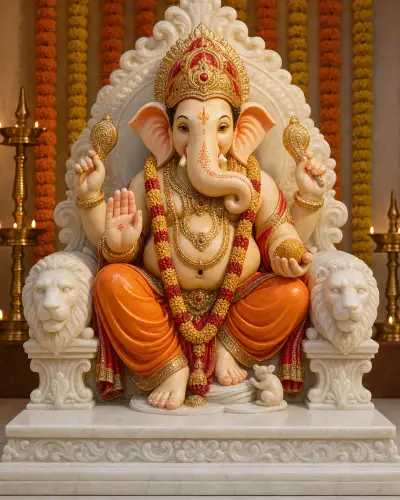
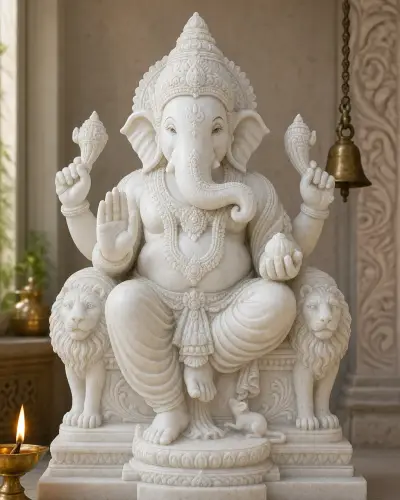
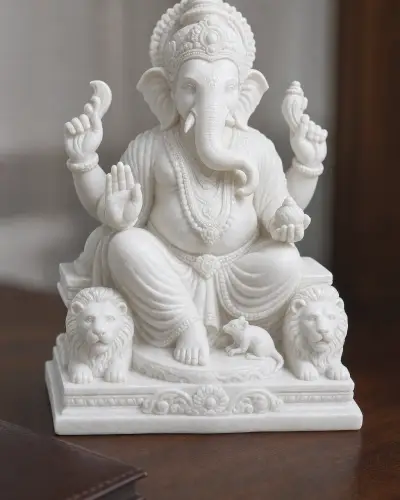
Makrana White Marble Lalbaugcha Raja on Grand Lion Throne with Prabhavali, 4 ft
Master-carved Makrana marble Lalbaugcha Raja on a lion-flanked simhasan, a 48-inch mandir centrepiece under a full prabhavali arch.
Made to order. The pictures here are concept images. This is not a ready item. We get it made for you as per this design, as close as possible, in the size and stone you choose.
Want this design made for you?
Tell us the size, the stone and where it is going. We will send you a quote and a timeline.
Chat on WhatsAppWe'll respond within 5 minutes
About This Piece
The pandal lineage and the Makrana marble
The Lalbaugcha Raja of Mumbai's Lalbaug market has drawn queues since 1934, when the traders and fishermen of the neighbourhood installed their first Ganpati after a vow was answered. That is the reason he is still called Navasacha Ganpati, the one who fulfils vows. This 4-foot piece carries that pandal form into stone: the broad seated Ganpati, the lion-flanked simhasan beneath him, the prabhavali torana arching over his crown. The marble is Makrana, quarried in the Nagaur district of Rajasthan and worked by carvers there for centuries; it is the same stone the Mughal builders chose for the facades of the Taj Mahal.
Carving the throne first, and the form it follows
Carving begins with the throne, not the deity. The lions on either arm and the openwork prabhavali are cut first, so the sculptor can judge how much stone the figure will need standing in front of them. Rough shaping is done with heavy chisels in successive passes; the face, the trunk, the four hands and the folds of the dhoti are then finished entirely by hand, with no machine tooling on any of them. The independent master sculptors we commission in Jaipur hand-polish the marble through progressive grades before the colour stage. Gilding and paint go on last (22k gold leaf on the mukut and the ornaments, hand-mixed polychrome on the figure), while the throne, the arch and the plinth are left bare so the stone still reads as stone.
Four arms is the canonical count for a pandal Ganpati at this scale. The front right hand is raised in abhaya, the gesture of reassurance; the front left holds a modak; the upper hands carry the ankusha and the pasha. His trunk curls to the left, the form preferred for household and mandir worship, and the right tusk is shown broken: Ekadanta, the single-tusked one. The mushak, his vahana, sits at the foot of the plinth with his face turned up. The prabhavali is not ornament alone. It frames him the way the pandal frames the original.
Clearance for a 4-foot murti, and other sizes
At 48 inches on its plinth, this is a mandir murti rather than a shelf piece. Allow roughly seven feet of clear wall behind and above it so the arch reads properly, and set it on a load-rated chowki or a masonry platform at chest height. Mandals usually place a piece this size centrally, with room to walk on three sides; in a large home shrine it works best against one uncluttered wall. Keep the gilded surfaces away from direct water during abhishek; a dry cloth and a soft brush are all the gold leaf and paint need.
The same form is carved from 24 to 60 inches, and in plain Makrana white without paint if you prefer the stone unadorned. Gold-leaf coverage can stay on the mukut alone or extend across the ornaments and the prabhavali. Share your sanctum dimensions on WhatsApp and we will size the throne and arch to the niche.
Specifications
Pose
Grand seated four-armed Lalbaugcha Raja Ganpati on an elaborately carved lion-flanked simhasan throne beneath a full prabhavali torana arch, trunk curled left, broken right tusk, modak and abhaya blessing, mushak at the base
Color
Traditional Polychrome with Gold Mukut
Finish
Hand-painted (polychrome)
Material
Makrana White Marble
Ideal For
Community mandir, Large home shrine, Temple installation
Weight In Kg
210
Depth In Inches
24
Width In Inches
26
Height In Inches
48
Region Or Tradition
Indian / Maharashtrian pandal form (Rajasthan-carved)