Sardar Vallabhbhai Patel Marble Bust Statue 24in
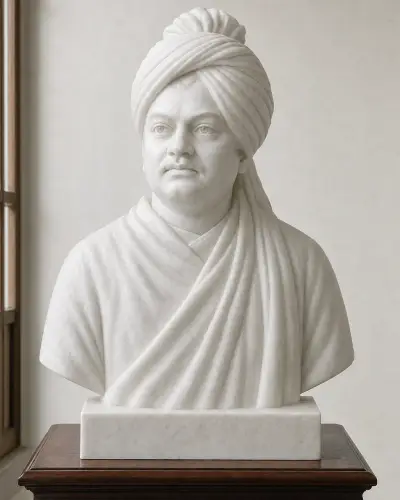
Master-carved Makrana white marble portrait bust of Sardar Vallabhbhai Patel. A 24-inch civic piece on a plain rectangular plinth.
Made to order. The pictures here are concept images. This is not a ready item. We get it made for you as per this design, as close as possible, in the size and stone you choose.
Want this design made for you?
Tell us the size, the stone and where it is going. We will send you a quote and a timeline.
Chat on WhatsAppWe'll respond within 5 minutes
About This Piece
Getting the likeness right
A portrait bust succeeds or fails on the face. Sardar Vallabhbhai Patel is among the most photographed figures of the freedom movement, and the public carries a fixed picture of him: the clean-shaven scalp, the wide forehead, the heavy jaw set square under drawn cheeks, the mouth closed in a line that gives nothing away. This 24-inch bust is cut to that record rather than to an idealised type. The head sits level and faces straight ahead; the plain cotton kurta buttons at the throat, and a shawl falls in folded pleats across one shoulder, the way he wears it in the Bardoli photographs of 1928, when the farmers of that Gujarat taluka gave him the title Sardar. A memorial piece has only one real test: someone who grew up with the textbook portrait should know him from across the room.
Makrana white marble
The stone is Makrana white marble, quarried in the Nagaur district of Rajasthan, which is the same source that faced the Taj Mahal in the 1630s and still supplies the stone yards of Jaipur. It is a dense calcite marble with a fine, lightly sugary crystal: hard enough to hold a sharp edge on a collar or a plinth arris, fine enough to carry the soft transitions of a cheek or an eyelid without breaking up. Light travels a short way into the surface before it returns, so the face reads as tissue rather than as chalk, and that translucency is why portrait sculptors have preferred white marble to almost every other stone. Expect grey hairline veining across part of the surface; it is natural stone, and no two blocks match. The finish is a soft satin polish, which keeps the glow without the glare a mirror polish throws across a face.
How the bust is made
Work starts from photographs. Send whatever the family or the institution holds (archival prints, a garlanded frame from an office wall, a book plate), and the sculptors we work with build the head up in clay first, so proportion and the set of the jaw can be corrected before a chisel touches stone. Only then is the block set out and roughed down to the mass. Machines take off that weight, as they do in every serious stone yard in Rajasthan; what decides the piece is the hand work after. The brow, the lids, the corners of the mouth and the fall of the shawl are all modelled and rubbed down by hand. We review the clay with you, brief the sculptor on the corrections you want, and follow the piece through to the day it is set on its pedestal.
Scale, weight and installation
At 24 inches from the crown to the base of the plinth, this sits a shade over life size. That is the scale most civic and institutional busts are cut to, because it reads correctly from six or eight feet away without taking over a lobby. In solid Makrana marble the bust and its integral plinth come to roughly 85 kg, so whatever carries it has to be masonry, stone or a braced steel frame, never a hollow display column. Set that pedestal between 40 and 48 inches and the eyes land at adult standing eye level, which is what makes a portrait feel present rather than exhibited. Pieces this size usually go into the foyer of a school or college, a municipal or panchayat hall, a trust or society office, a park plinth under a chhatri, or a family memorial room.
Make it yours
The same portrait can be cut larger for an outdoor plinth or smaller for a desk, and in black stone or Vietnam white marble where the setting calls for a different tone. The plinth face is the usual place for an inscription (name, dates, and whatever line the institution wants under them), carved in Devanagari, Gujarati or English, or set in inlaid brass letters. A matching marble pedestal can be cut to the height your floor needs, and a second bust can be worked as a pair for a twin installation. Send your photographs, tell us where it will stand, and we will come back with sizes and options.
Specifications
Pose
Head-and-shoulders portrait bust of Sardar Vallabhbhai Patel, bald with a broad heavy-jawed face, a plain kurta with a shawl folded over one shoulder, firm closed-lip expression, on a plain rectangular plinth
Color
White
Finish
Soft polish (satin)
Material
Makrana White Marble
Ideal For
institution, commemoration, memorial
Weight In Kg
85
Depth In Inches
11
Width In Inches
16
Height In Inches
24
Region Or Tradition
Indian / Gujarati (Sardar Patel commemorative portraiture)