Swami Vivekananda Marble Bust Statue 24in in Makrana White
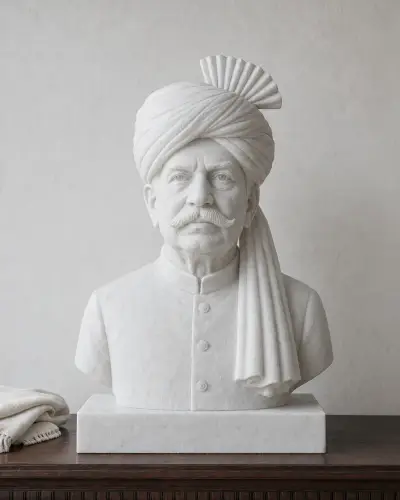
Sculptor-carved Makrana white marble bust of Swami Vivekananda: a 24-inch portrait for ashram halls, school foyers and trust offices.
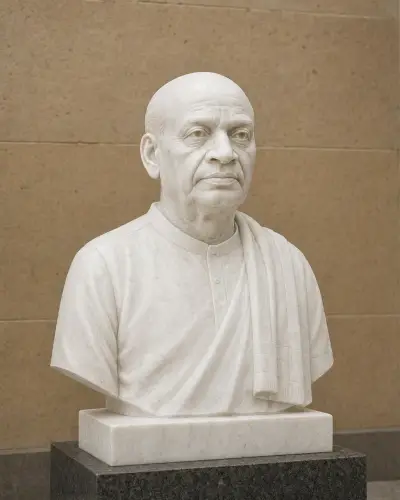
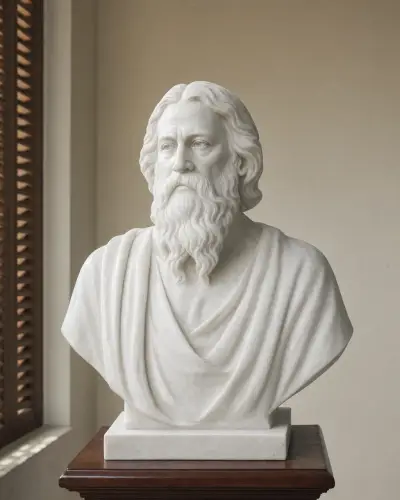
Made to order. The pictures here are concept images. This is not a ready item. We get it made for you as per this design, as close as possible, in the size and stone you choose.
Want this design made for you?
Tell us the size, the stone and where it is going. We will send you a quote and a timeline.
Chat on WhatsAppWe'll respond within 5 minutes
About This Piece
The stone
Makrana white marble is quarried at Makrana in Nagaur district, Rajasthan, from the same beds that supplied the Taj Mahal and have been worked more or less continuously for five centuries. It is a dense, close-grained calcite marble with a bright natural white body and only the faintest warm undertone, crossed here and there by grey hairline veins no wider than a pencil line. That density is what makes it the right stone for a portrait rather than a decorative figure: the grain holds an eyelid, the ridge of a moustache and the folded edge of a turban without crumbling at the arris. Finished to a soft satin polish rather than a mirror gloss, the surface keeps a little tooth, so light rakes across the face and reveals the modelling instead of glaring off it.
The likeness
Swami Vivekananda is carved here as a head-and-shoulders portrait: the wound cloth turban with its tail falling over one shoulder, a plain monastic robe drawn across both shoulders, a broad calm face with a short moustache and a level, unhurried gaze. It is the figure most people recognise from the 1893 Parliament of Religions photographs taken in Chicago, and from the portraits that hang in Ramakrishna Math and Mission centres across India. Because this is a portrait and not a devotional murti, the work is judged on likeness: the set of the jaw, the width between the eyes, the weight of cloth where it turns over the shoulder. The face, the turban folds and the drape are finished entirely by hand after the block has been roughed out.
Sizing it for a hall
At 24 inches tall the bust stands close to life size, roughly 16 inches across the shoulders, 10 inches deep, and about 68 kilograms with its plinth. That makes the pedestal a structural question, not just a decorative one: solid masonry or hardwood, never a hollow console. The usual arrangement puts the pedestal at 40 to 44 inches so the eyes of the bust meet the eyes of a standing adult; set it lower and visitors look down on the face, set it higher and the underside of the jaw dominates. Allow about three feet of clear wall behind, and keep that wall plain. Marble this bright is the lightest thing in the room and reads best with nothing patterned competing beside it.
Making it yours
A portrait bust of Swami Vivekananda is commissioned rather than picked off a shelf, so most of it is open to you. The height can move to 18 or 30 inches, the stone to black granite for a darker and more formal reading, and the plinth can stay squared as it is here or take a simple moulded edge. Trusts and schools often ask for a name and dates lettered into the front face of the plinth, or for a brass plate to be fitted instead. The same route works for a family portrait: the master sculptors we work with build a likeness from photographs, and you approve a clay model before a chisel touches the marble. Tell us the room, the height you have to work with and the occasion, and we will come back with a scope.
Specifications
Pose
Head-and-shoulders portrait bust of Swami Vivekananda in his wound cloth turban, a plain monastic robe drawn over both shoulders, broad calm face with a steady level gaze, on a plain rectangular plinth
Color
White
Finish
Soft polish (satin)
Material
Makrana White Marble
Ideal For
institution, commemoration, memorial
Weight In Kg
68
Depth In Inches
10
Width In Inches
16
Height In Inches
24
Region Or Tradition
Indian / Bengali (Ramakrishna Math and Mission tradition)