Handcrafted Marble Dust Katyayani Devi Statue, 18in
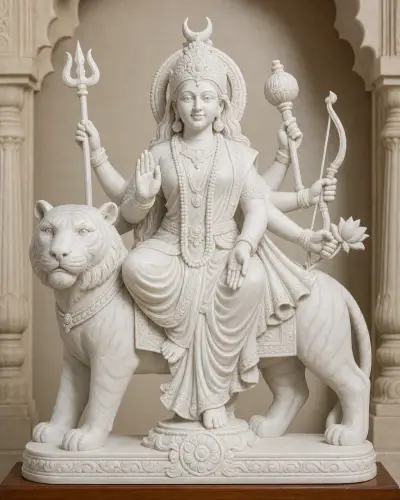
Studio-cast marble dust Katyayani Devi seated in padmasana, an 18-inch home-altar murti with her lion at rest and a soft satin finish.
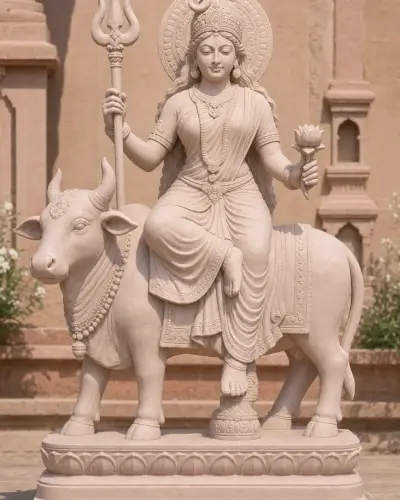
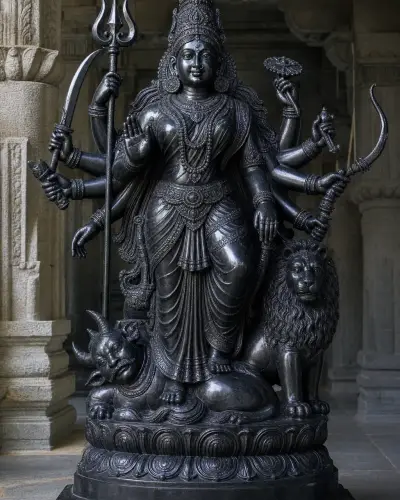
Made to order. The pictures here are concept images. This is not a ready item. We get it made for you as per this design, as close as possible, in the size and stone you choose.
Want this design made for you?
Tell us the size, the stone and where it is going. We will send you a quote and a timeline.
Chat on WhatsAppWe'll respond within 5 minutes
About This Piece
What marble dust is, and how it is finished
Marble dust composite is not quarried. It is cast. Crushed marble left over from the Rajasthan stone trade is bound with resin, poured into a sculptor's mould and cured hard. At arm's length it carries the natural white tone and quiet density of solid marble at roughly a third of the cost, and it is light enough to lift onto a shelf with one hand. On this 18-inch Katyayani the grain reads very fine and uniform, with a faint speckle of calcite catching the light across the folds of her sari and along the lotus petals.
Every piece begins with a master model hand-sculpted by one of the independent Jaipur studios TMW works with. The mould is drawn from that model, the composite is cast, and then the real work begins. The crown, the face, the fingers curled around the lotus stem and the lion's mane are all hand-finished with fine files and progressive sanding. Nothing on the face or the hands is left to the mould line. The surface is taken to a soft satin polish: bright enough to catch altar light, matte enough to keep every strand of jewellery legible.
Katyayani's Navratri form and where she sits
Katyayani is the sixth of the nine Navadurga forms, honoured on the sixth night of Navratri. She is named for the sage Katyayana, in whose ashram the Puranas say she took form to end Mahishasura. The Bhagavata Purana records the gopis of Braj keeping the Katyayani vrata through the month of Margashirsha, which is why she is remembered as the goddess prayed to for a good match and a settled household. Here she is seated rather than in battle, the sword still raised, a lotus held aloft, the remaining hands in abhaya (fear not) and varada (the granting of a wish), and her lion resting beneath the lotus seat.
At 18 inches she is built for a shelf, not a floor. Allow about ten inches of width and a hand's breadth of clearance behind the crown; a mandir niche, a wall-mounted altar or the upper shelf of a wooden pooja unit all suit her. Home shrines are customarily set in the north-east of the house with the murti facing west, so the person praying looks toward the sunrise. Because the casting is light, she also travels well. Families who set out all nine Navadurga forms through Navratri can bring her out and put her away without a second pair of hands.
Other sizes, stones and a painted finish
Everything is made to order. The same Katyayani can be cast at 12, 24 or 30 inches, carved instead in solid Makrana or Vietnam white marble if you want quarried stone, or hand-painted in traditional polychrome with a gilded crown for a festival altar. Tell us the shelf you are filling and we will size her to it.
Specifications
Pose
Katyayani — seated in padmasana on a lotus pedestal, multi-armed holding sword and lotus with the right hands raised in abhaya and varada, her lion resting at the base, crowned, full sari and ornaments, serene warrior-ascetic expression
Color
Cast White
Finish
Soft polish (satin)
Material
Marble Dust Composite
Ideal For
Small home altar, Navratri set, Affordable gifting
Weight In Kg
11
Depth In Inches
9
Width In Inches
10
Height In Inches
18
Region Or Tradition
Indian / North Indian (Braj, Katyayani tradition)