Vietnam White Marble Jain Corner Derasar with Jali Walls — 51 in
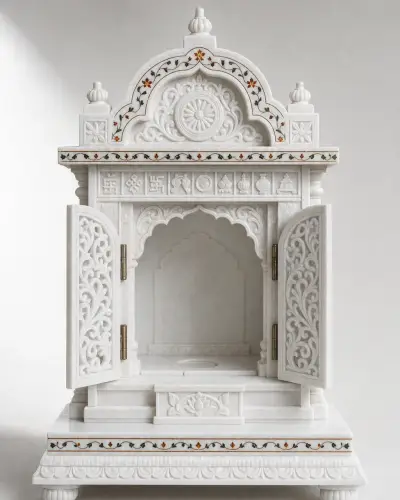
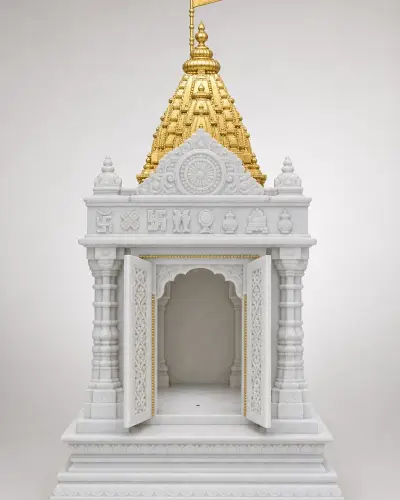
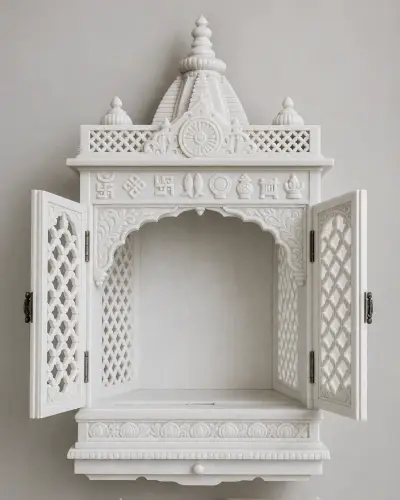
Hand-carved Vietnam white marble Jain derasar on a triangular corner plan, 51 inches, with pierced jali walls and a tiered shikhar with kalash.
Made to order. The pictures here are concept images. This is not a ready item. We get it made for you as per this design, as close as possible, in the size and stone you choose.
Want this design made for you?
Tell us the size, the stone and where it is going. We will send you a quote and a timeline.
Chat on WhatsAppWe'll respond within 5 minutes
About This Piece
A derasar shaped for the corner of the room
Most home derasars need a wall. This one needs the place two walls meet. The Vietnam white marble shrine is built on a triangular corner plan, so the back of it folds into a ninety-degree angle and the carved face turns out into the room on the diagonal, with the double doors, the sanctum and the shikhar all reading straight on to anyone standing in front of it. At fifty-one inches it is a full-height piece rather than a tabletop one, with a stepped triangular plinth carrying the weight down to the floor. For a flat, a condo or an American living room where every straight wall is already spoken for by a sofa, a television or a window, the corner is usually the only volume left, and this shrine is drawn to occupy it properly instead of being pushed into it.
Jali walls, and the symbols carved into them
Both visible faces of the derasar are pierced jali, lattice cut clean through the marble rather than carved into its surface, so daylight and lamplight pass through the sanctum and the screen reads as light as it does solid. A carved medallion sits at the centre of each jali panel, and a frieze of the eight ashtamangal symbols runs across the lintel above the doors: the swastika with its three dots and the crescent siddhashila, the shrivatsa, the nandyavarta, the paired fish, the mirror, the kalash, the bhadrasan and the vardhamanaka. A circular siddhachakra medallion is carved above the door arch. The vocabulary is Gujarati Shvetambar Murtipujak throughout, and deliberately so: nothing on the shrine borrows from another tradition.
Vietnam white marble, and why it suits a pierced screen
The stone is Vietnam White Marble, quarried around Thanh Hoa province and chosen here for two reasons. Its colour is a cool, neutral, almost porcelain white, brighter and less creamy than Makrana, which keeps a shrine of this scale from turning yellow under warm evening lamplight. More practically, its grain is fine and crystalline rather than open, and a jali lives or dies on that: every pierced rib is a thin bridge of stone, and a coarse-grained block would fracture along a vein as the drill broke through. The surface is taken to a honed matte finish, so the shikhar tiers and the jali edges hold a soft broad highlight instead of a hard reflection, and the carving stays legible from across the room.
Living with it, and making it yours
The gabhara is supplied empty, with two hinged carved doors and a shallow prakshal channel cut into the sanctum floor to carry abhishek water away. Choose and install your own Tirthankar murti. The sanctum opening on this fifty-one inch piece takes a seated murti comfortably up to about eleven inches. The shrine stands roughly thirty inches across the front diagonal and twenty deep into the corner, and weighs on the order of one hundred and fifteen kilos, so it wants a solid floor rather than a raised wooden platform. A concealed warm LED strip behind the lintel is the usual lighting. Height, the door treatment, and the decoration itself can all change: the jali can give way to parchin kari inlay, gold leaf or plain carved panels, and a family name can be engraved into the plinth.
Specifications
Pose
Corner-plan derasar on a triangular footprint that sits into the angle of two walls — pierced jali lattice to both visible faces, double hinged doors on the diagonal shown standing open, a tiered shikhar with kalash and dhwaja, carved ashtamangal medallions at the jali centres, an ashtamangal frieze across the lintel with a siddhachakra medallion above the door arch, a shallow prakshal drainage channel in the sanctum floor, all on a stepped triangular plinth
Color
Natural White
Finish
Matte (honed)
Material
Vietnam White Marble
Ideal For
Corner shrine in a US living room, Condo with no spare wall, Space-saving derasar
Decoration
jali_lattice
Weight In Kg
115
Depth In Inches
20
Width In Inches
30
Height In Inches
51
Decoration Detail
Pierced jali lattice cut clean through both visible wall faces in a fine diagonal net, with a carved ashtamangal medallion worked into the centre of each panel; the doors are carved solid against the open screen so the sanctum reads as the still point of the piece
Region Or Tradition
Indian / Gujarati (Shvetambar Murtipujak derasar tradition)