Vietnam White Marble Shrinathji Murti with Carved Vagha, 21 in
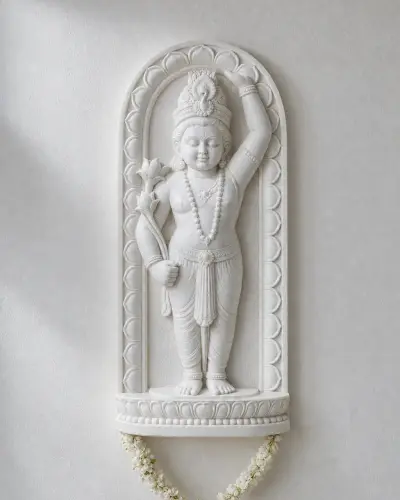
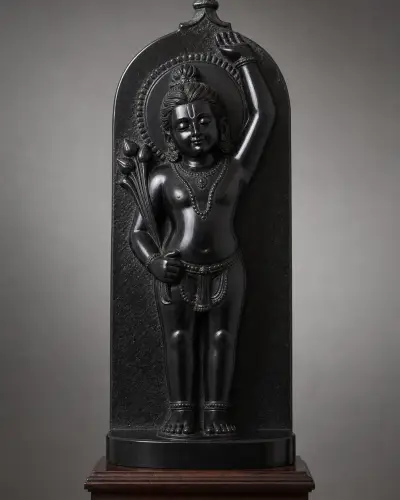
Master-carved Vietnam white marble Shrinathji: a 21-inch bas-relief svarupa with the vagha folds and gunja mala worked in deep relief.
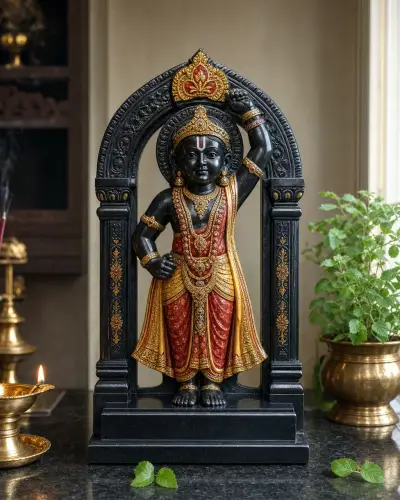
Made to order. The pictures here are concept images. This is not a ready item. We get it made for you as per this design, as close as possible, in the size and stone you choose.
Want this design made for you?
Tell us the size, the stone and where it is going. We will send you a quote and a timeline.
Chat on WhatsAppWe'll respond within 5 minutes
About This Piece
The Vietnam white marble, and why no paint
Shrinathji stands here as he does at Nathdwara: a bas-relief svarupa on an arched stele, his left arm lifted above the head to the curve of the arch, his right hand closed in a fist at the waist. The form is cut in Vietnam white marble from Thanh Hoa province, a cool, close-grained milky stone that has become the working white of Indian statuary since the 2000s, brighter and far less creamy than Makrana. Against that flat clean white the vagha reads as pure light and shadow: no colour, no paint, only depth.
Carved by hand, and the form that cannot change
The piece is carved to order by the master sculptors we work with in Jaipur, and every part of it is done by hand. A rough block is squared and the stele outline struck first, then the figure is brought forward in stages. The drapery is cut deep enough that a raking skylight does the work a painted vagha would otherwise do, the gunja mala is worked bead by bead across the chest, and the U-shaped tilak and the child's rounded cheeks are left for last. Face, hands and folds never see a machine; those go to the finest chisels and then to progressive hand polish, stopped at a satin sheen rather than a mirror so the carving keeps its shadows.
Every part of the posture is fixed by the Pushtimarg tradition and is not open to interpretation. The raised left arm is Govardhan held aloft (the hill itself is never carved, it is implied), and it falls on your right as you stand before him. The fist at the waist, thumb just showing, is the other constant. Both feet are flat and frontal, and the swaroop is a seven-year-old child rather than a youth: rounded face, soft cheeks, hair gathered in a top-knot under the mukut. The gunja mala and the deep vagha folds are what separate a Shrinathji svarupa from every other Krishna form, and there is no flute anywhere in it.
Placing a 21-inch murti in a home mandir
At 21 inches the murti works as the central swaroop of a home mandir rather than as an accent, and it wants a plain wall behind it, because relief carving is only legible when nothing competes with the shadow line. A skylight, or a recessed downlight set slightly off to one side, will pick out the drapery; flat frontal lighting flattens it. Allow roughly nine inches of shelf depth for the stele and its lotus base, and keep the mukut clear of any overhang above.
Scaling the svarupa, or changing the stone
We design each commission with you before anything is cut. The same svarupa can be scaled up for a larger mandir, taken to Makrana white marble or black stone, or given a shallower base if your shelf is tight. Send us your mandir's dimensions and we will work back from there.
Specifications
Pose
Standing bas-relief svarupa on an arched stele — left arm raised aloft to touch the arch, right hand a closed fist at the waist with the thumb out, both feet straight, flat and frontal, U-shaped tilak, top-knot under a carved mukut, depicted as a seven-year-old child
Color
Milky White
Finish
Soft polish (satin)
Material
Vietnam White Marble
Ideal For
Home mandir, Modern interior, Large pooja room
Weight In Kg
28
Depth In Inches
5
Width In Inches
12
Height In Inches
21
Region Or Tradition
Indian / Rajasthani (Nathdwara, Pushtimarg tradition)