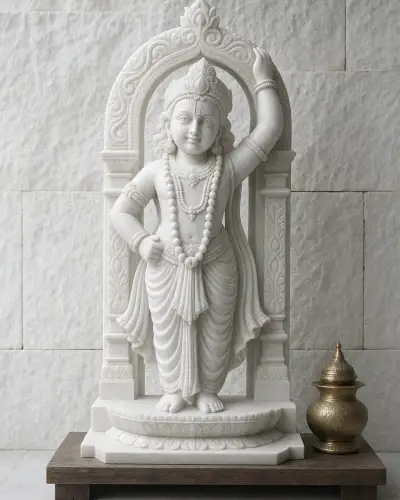
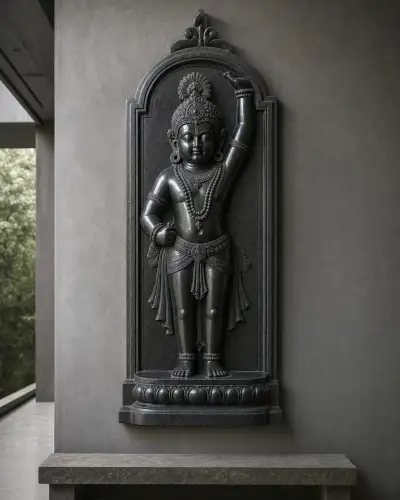
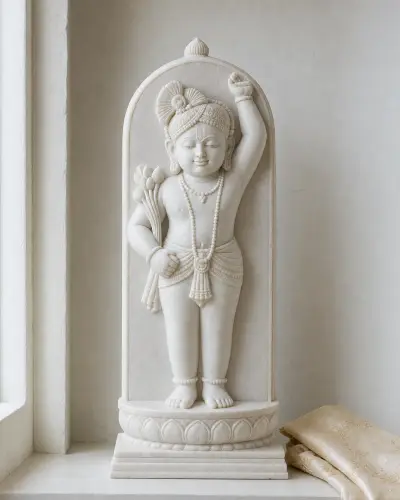
White Marble Shrinathji Wall Panel, 30 in
Sculptor-carved Vietnam white marble Shrinathji relief, a 30-inch wall panel for mandirs too shallow for a standing murti.
Made to order. The pictures here are concept images. This is not a ready item. We get it made for you as per this design, as close as possible, in the size and stone you choose.
Want this design made for you?
Tell us the size, the stone and where it is going. We will send you a quote and a timeline.
Chat on WhatsAppWe'll respond within 5 minutes
About This Piece
Why the svarupa is carved as a relief
Shrinathji is worshipped at Nathdwara in Rajasthan as a seven-year-old child, and the svarupa there is not a figure in the round. It is a relief cut into a single block of stone. This panel keeps that discipline. The svarupa stands in shallow relief inside a carved lotus-petal arch: his own left arm lifted to the top of the arch, his right hand closed in a fist at the waist, both feet flat and frontal on the lotus plinth. The stone is Vietnam white marble from Thanh Hoa province, a cool clean white with a fine crystalline grain that holds a shallow cut without veining fighting the carving.
How the panel is carved, and what is fixed
Relief is a harder brief than a statue in the round. Depth has to read from one viewing angle, so the sculptor works the arch, the background field, the body and the ornament as a stack of shallow steps rather than a modelled volume. The master sculptors we work with in Jaipur rough the block, set the arch and the petal border, then bring the face, hands and dhoti folds up by hand at the end. Nothing on the face or the hands is machine-finished. We design the panel with you, brief the sculptor, and follow the piece through to your door.
Every marker on this svarupa is fixed by the Pushtimarg tradition, and none of it is decoration. The raised left arm is Govardhan lifted; the hill itself is never carved, because the gesture carries it. The closed right fist with the thumb out, the U-shaped urdhva-pundra tilak, the half-closed downcast eyes, the lotus stalks tucked into the crook of the right arm and the gunja mala at the neck all belong to the form. There is no flute. Shrinathji is not shown playing one, and a bansuri in the hands would make this a different deity altogether.
Wall space, weight and light for a 30-inch panel
At 30 inches the panel reads from across a room while occupying about 14 inches of wall, which is the whole argument for it. A mandir niche or a slim console rarely has the depth for a standing murti at this scale; a relief needs a wall and roughly three inches of clearance. Raking side light is what makes it work. A window to one side, or a small downlight set off-axis, pulls the carving out, while flat frontal light will flatten it. Plan the fixing for the weight: at about 42 kg it goes into masonry, not a plasterboard partition.
Other heights, stones and arch treatments
This Shrinathji svarupa can be cut at other heights, in Makrana white marble or black stone, and the arch can stay plain or carry the stele fauna of the Nathdwara original. Send us the wall dimensions and the niche depth, and we will work the proportions back from there.
Specifications
Pose
Wall-mounted bas-relief on an arched stele — the svarupa in shallow relief within a carved lotus-petal border, left arm raised to the arch, right hand a closed fist at the waist, feet flat and frontal
Color
Milky White
Finish
Soft polish (satin)
Material
Vietnam White Marble
Ideal For
Wall mounted, Home mandir, Living room
Weight In Kg
42
Depth In Inches
3
Width In Inches
14
Height In Inches
30
Region Or Tradition
Indian / Rajasthani (Nathdwara, Pushtimarg tradition)