Makrana White Marble Shrinathji Murti, 18 in
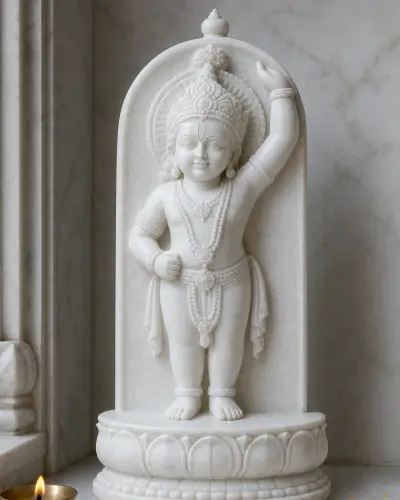
Sculptor-carved Makrana white marble Shrinathji. The Nathdwara svarupa as an 18-inch arched stele for a home mandir built in light stone.
Made to order. The pictures here are concept images. This is not a ready item. We get it made for you as per this design, as close as possible, in the size and stone you choose.
Want this design made for you?
Tell us the size, the stone and where it is going. We will send you a quote and a timeline.
Chat on WhatsAppWe'll respond within 5 minutes
About This Piece
The Makrana block and the arched stele
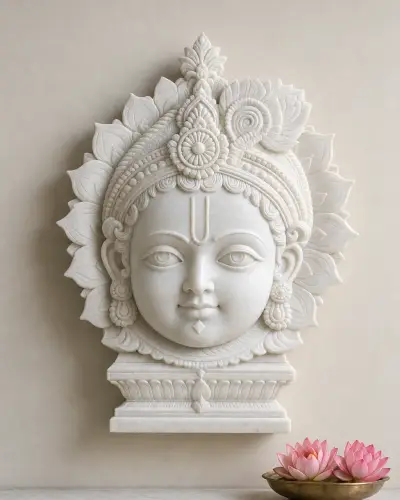
Shrinathji is carved here as he is meant to be seen, as a svarupa in relief against a plain arched stele, not a figure standing free in the round. The stone is Makrana white marble from Nagaur district in Rajasthan, quarried since the fourteenth century and the same stone that faces the Taj Mahal. It reads as a bright natural white with a faint cream warmth rather than a cold blue-white, and its close, lightly sugary grain holds fine detail (the beaded malas, the folded patka, the U of the tilak) without crumbling at the edges. At 18 inches the stele and its stepped lotus plinth are worked from a single block.
How the Shrinathji murti is carved
Every piece is made to order. We design it with you, including the proportions, the depth of the relief and how plain or how worked the arch should be, then brief the sculptor and follow the work through to your door. It is carved for you by the master sculptors we work with in Jaipur, artist families who have shaped devotional stone for generations: rough block, primary massing, then the slow detail pass in which the face, the hands and the ornament are cut and finished entirely by hand. Nothing machine-finished goes near the face. The satin polish is brought up by hand so the surface glows rather than mirrors, and light settles into the carving instead of bouncing off it.
The Nathdwara iconography this follows
The svarupa follows Nathdwara exactly. His left arm is raised above the head, the hand cupped and reaching the arch. This is the lifting of Govardhan, carried by the gesture alone, which is why no hill is ever shown. The right hand is closed in a fist at the waist with the thumb out, the feet stand flat and frontal, and lotus stalks rest in the crook of the right arm. He is a child of about seven, eyes half-closed and downcast, wearing the U-shaped urdhva-pundra tilak of the Vallabh Sampradaya. There is no flute. Shrinathji is not the Venugopal form, and the Pushtimarg tradition founded by Vallabhacharya has held this iconography fixed since the murti settled at Nathdwara in 1672.
Fitting an 18-inch stele in a niche
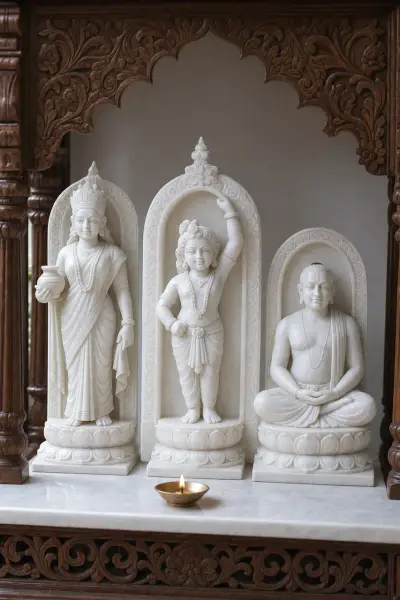
An 18-inch stele suits a home mandir or a wall niche where the murti is met close and daily rather than seen across a room. Allow roughly 24 inches of clear height above the shelf so the arch is not crowded. The flat back sits against a rear wall or inside a shallow alcove, and the depth of the relief keeps the shadow line legible under a single soft downlight. Light stone also takes shringar well: vagha, mala and mukut can change with the season, and the marble stays the quiet thing behind them.
Sizes from 9 to 36 inches
Sizes run from 9 inches for a compact mandir up to 36 inches for a larger shrine, in Makrana white marble, Vietnam white marble, black stone, Dholpur pink sandstone or cast marble dust. The arch can stay plain, as here, or carry the carved stele companions: cows, lion, peacocks, parrot and sages. Send us your niche measurements on WhatsApp and we will work the proportions back from them.
Specifications
Pose
Standing bas-relief svarupa on a plain arched stele — left arm raised to the arch, right hand in a fist at the waist, lotus stalks in the crook of the right arm, feet flat and frontal
Color
Warm White
Finish
Soft polish (satin)
Material
Makrana White Marble
Ideal For
Home mandir, Pooja room, Daily darshan
Weight In Kg
20
Depth In Inches
5
Width In Inches
9
Height In Inches
18
Region Or Tradition
Indian / Rajasthani (Nathdwara, Pushtimarg tradition)