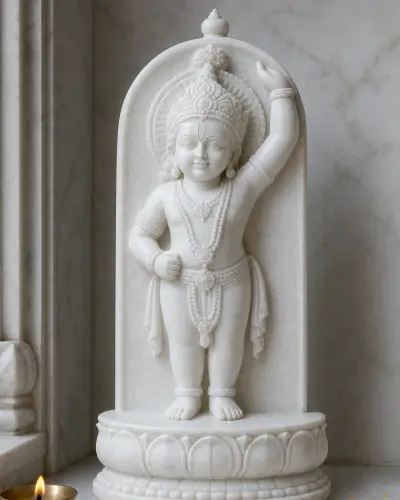
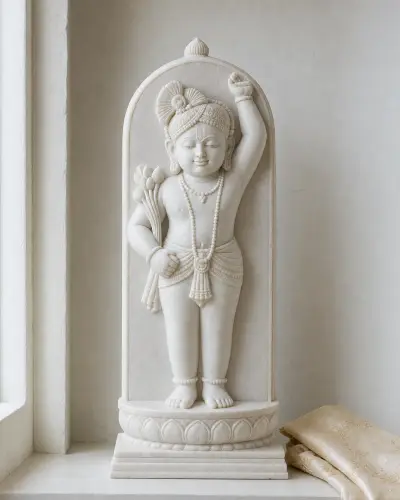
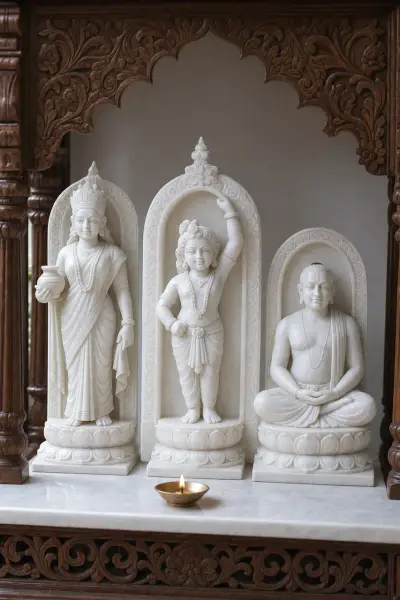
Shrinathji Mukharvind Marble Wall Panel, 18 in
Master-carved Makrana white marble mukharvind: the Shrinathji lotus-face darshan as an 18-inch relief panel for a home mandir wall.
Made to order. The pictures here are concept images. This is not a ready item. We get it made for you as per this design, as close as possible, in the size and stone you choose.
Want this design made for you?
Tell us the size, the stone and where it is going. We will send you a quote and a timeline.
Chat on WhatsAppWe'll respond within 5 minutes
About This Piece
The mukharvind face, cut in Makrana marble
The mukharvind (literally the lotus face) is how Pushtimarg devotees speak of Shrinathji's darshan at Nathdwara, where the swaroop has stood in the Mewar hills of Rajasthan since 1672. This 18-inch panel takes that face alone and works it in relief: the wide lotus eyes, the urdhva-pundra tilak drawn up the forehead, the diamond set just beneath the lower lip, all of it held inside a ring of carved lotus petals with a sarpech and kalgi crest rising from the crown. The stone is Makrana white marble from Nagaur district, quarried a few hours' road from Nathdwara itself and worked in Indian temple and palace building for centuries.
How the relief is worked from a single plane
Relief work of this kind runs slower than carving in the round, because everything has to read from a single frontal plane. The sculptors we work with in Jaipur block the panel first, then bring the face forward in stages (brow, cheek, the soft child jawline) before the petal ring and the crown ornament are cut back around it. The face, the eyes and the tilak are finished entirely by hand; no machine touches them. A soft satin polish is carried over the raised surfaces so the marble catches light without turning glassy, while the recesses stay matte and hold the shadow that gives a relief its depth.
Why the mukharvind keeps a child's face
Shrinathji is Krishna at about seven years old, the age at which he lifted Govardhan, and the mukharvind keeps that childhood in the modelling: rounded cheeks, a small mouth, an unhurried half-smile. Nothing of the flute-playing Venugopal belongs here. This is a separate swaroop with its own vocabulary. At Nathdwara the face is the whole of the darshan; the shringar and the pichwai behind it change through the eight daily viewings, but the mukharvind is what the devotee comes to see, and that is what this panel is.
Hanging the 18-inch panel above a mandir ledge
An 18-inch panel hangs comfortably above a mandir ledge, in a puja room, or on an entrance wall the family passes daily. Allow about a foot of clear wall on either side, since the petal ring needs that space to read. Mount it at standing eye level or a little above, since the gaze is meant to come down to the viewer. A pair of lotus blooms in a brass urli on the ledge below is the traditional treatment, and it is enough; the panel does not want company on the wall.
Making it larger, smaller or plainer
We design each piece with you and follow it through to your door. This one can be made larger for a temple wall or smaller for an apartment mandir, in Makrana or Vietnam white marble, and the crown ornament can be simplified or enriched to sit with an existing shrine. Message us on WhatsApp with the wall you have in mind.
Specifications
Pose
mukharvind wall panel — the lotus-face darshan alone carved in relief, large lotus-shaped eyes gazing outward, U-shaped tilak, a diamond mark beneath the lower lip, encircled by carved pink-lotus petals with a sarpech and kalgi crest worked into the crown of the panel, the face that of a young child of about seven years — rounded cheeks and a soft child jawline, not an adolescent or an adult
Color
Warm White
Finish
Soft polish (satin)
Material
Makrana White Marble
Ideal For
Wall mounted, Home mandir, Gifting
Weight In Kg
22
Depth In Inches
4
Width In Inches
14
Height In Inches
18
Region Or Tradition
Indian / Rajasthani (Nathdwara, Pushtimarg tradition)