Small Marble Shrinathji Murti on Lotus Chowki, 9 in
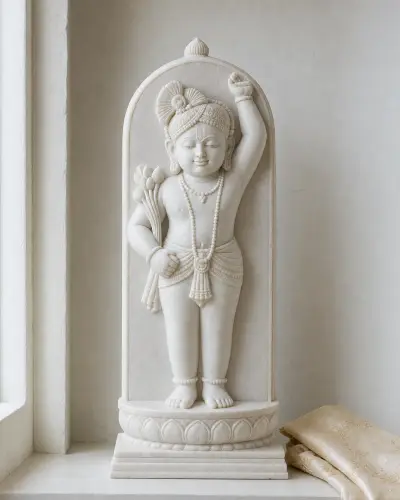
A 9-inch Makrana white marble Shrinathji on a carved lotus chowki. Hand-finished, and small enough for an apartment mandir shelf.
Made to order. The pictures here are concept images. This is not a ready item. We get it made for you as per this design, as close as possible, in the size and stone you choose.
Want this design made for you?
Tell us the size, the stone and where it is going. We will send you a quote and a timeline.
Chat on WhatsAppWe'll respond within 5 minutes
About This Piece
The Nathdwara form, in Makrana white marble
Nathdwara is where this form comes from. The svarupa of Shrinathji, Krishna as a child of about seven with his left arm lifted to hold up Govardhan, has been served there in Mewar since the late seventeenth century, and the marble murtis carried home from that town follow its posture closely. This nine-inch piece is carved in Makrana white marble, quarried in Nagaur district, Rajasthan, the same stone the Taj Mahal was faced with. It reads bright natural white with a faint warm undertone and fine grey hairline veining, and takes a soft satin polish that keeps the face readable in low mandir light.
Figure, stele and chowki from one block
Carving is done by the master sculptors we work with in Jaipur, and at this scale the whole piece (figure, arched stele and lotus-petal chowki) comes out of a single block, so there is no join to fail. The sculptor blocks the silhouette, cuts the arch and the petal ring, then works the relief forward: the jewellery, the pleated dhoti, the toes overhanging the chowki edge. The face, the raised cupped hand and the closed fist are finished entirely by hand, with no machine tooling anywhere near them. A graded polish follows, stopping at satin rather than mirror.
The markers that make it a Nathdwara swaroop
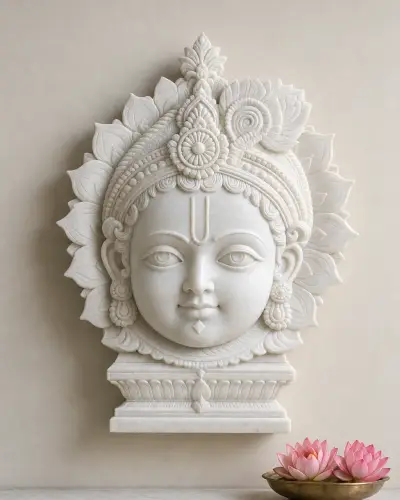
Every marker of the Nathdwara swaroop is here, and none of it is decorative. The left arm goes up with the palm cupped against the arch, Govardhan hill raised over the village, while the right hand stays closed in a fist at the waist, thumb out. Both feet are flat and frontal. The proportions are deliberately a child's, with a rounded face and soft cheeks, and the U-shaped Vaishnava tilak sits on the forehead. Households in the Pushtimarg (Vallabh Sampradaya) tradition attend the murti through the day as they would a child, which is why so many want the swaroop within arm's reach rather than high on a wall.
Where a nine-inch murti sits, and other sizes
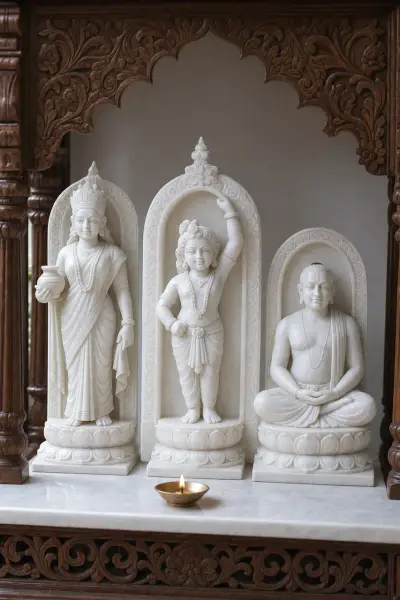
Nine inches is the size most home mandirs actually start at. The piece needs roughly a foot of clear shelf, sits on an apartment mandir's middle tier without crowding the diya and the thali, and travels well to an office cabin or a cupboard shrine. Set it so the face lands near eye level when you are seated for darshan. The relief is cut to be read from the front and flattens when viewed sharply from above. The chowki is flat-bottomed, so no separate stand is needed.
Any part of this can change. The same swaroop is made from nine inches up to temple scale, and in Vietnam white marble, black stone, Dholpur pink sandstone or cast marble dust as well as Makrana. We design it with you, brief the sculptor, and follow the piece through to your door, including a name or a date engraved on the chowki if it is going out as a gift.
Specifications
Pose
Standing bas-relief svarupa on an arched stele with an integral lotus-petal chowki — left arm raised aloft with the palm cupped against the arch, right hand closed in a fist at the waist, child proportions, U-shaped tilak
Color
Warm White
Finish
Soft polish (satin)
Material
Makrana White Marble
Ideal For
Apartment mandir, Office desk, Gifting
Weight In Kg
6
Depth In Inches
4
Width In Inches
5
Height In Inches
9
Region Or Tradition
Indian / Rajasthani (Nathdwara, Pushtimarg tradition)