Hand-Painted Makrana White Marble Neem Karoli Baba with Hanuman 30in
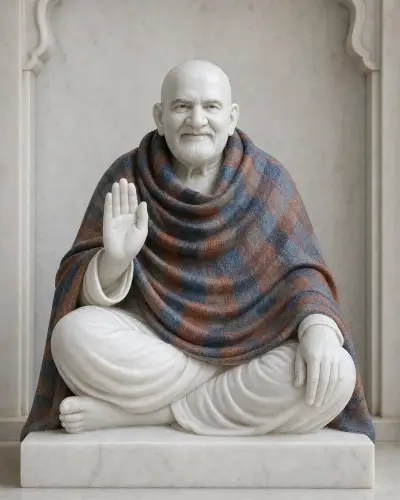
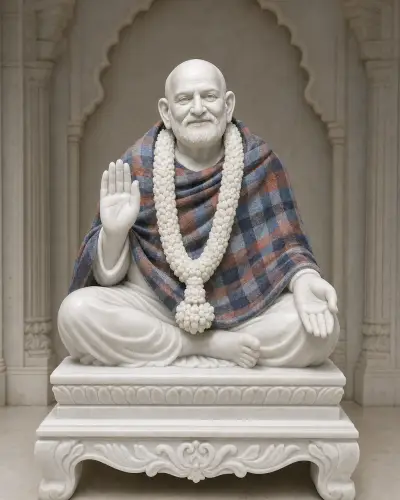
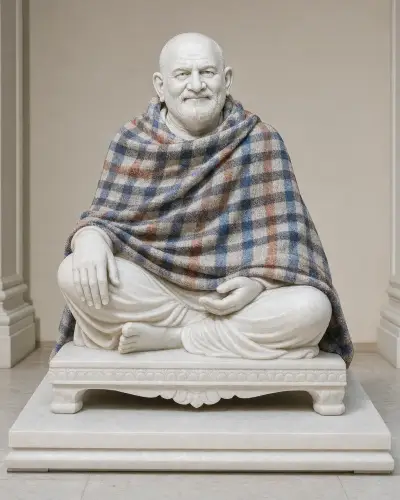
Hand-painted Makrana white marble Neem Karoli Baba in sukhasana with Hanuman behind: a 30-inch murti in his chequered plaid blanket.
Made to order. The pictures here are concept images. This is not a ready item. We get it made for you as per this design, as close as possible, in the size and stone you choose.
Want this design made for you?
Tell us the size, the stone and where it is going. We will send you a quote and a timeline.
Chat on WhatsAppWe'll respond within 5 minutes
About This Piece
The stone, and the paint laid over it
Makrana white marble comes out of the quarries in Nagaur district, Rajasthan, the same beds that supplied the Taj Mahal and the older havelis of Jaipur. It is a dense, low-porosity calcite marble, brilliant neutral white with a faint cream undertone and fine grey hairline veining, and it holds both a crisp chisel edge and pigment unusually well. On this 30-inch Neem Karoli Baba the stone is worked in two registers. The figures are hand-painted in full polychrome (warm skin tones, the white dhoti, the tartan checks of the blanket), while the rectangular plinth beneath them is left bare and unpainted, so the marble itself stays visible on the finished piece. Pigment is laid on in thin coats over a sealed surface and burnished back between them, which is why the checks read as woven wool rather than as flat colour. The face, the hands and the fall of the blanket are hand-finished throughout by the master sculptors Tilak Mandirwala works with in Jaipur.
Maharajji, and why the blanket is the whole point
Neem Karoli Baba, Maharajji to the devotees who filled Kainchi Dham, is recognised before anything else by his blanket. He is shown here seated cross-legged in sukhasana, easy rather than formal, wrapped in the heavy chequered plaid drawn over both shoulders and around the torso, its fringe falling loose across the plinth. Bare bald head, no turban and no head cloth. A short trimmed grey-white beard and moustache. A white dhoti at the waist and legs, bare feet forward, and the stout, broad build and warm, faintly amused elderly face that the photographic record of the 1960s and early 1970s preserved so completely. His right hand is raised open-palmed in ashirwad; the left rests easy on his knee. Every one of those details is load-bearing, because together they are what hold him apart from the other seated saints. Nothing here is idealised, abstracted or stylised.
Hanuman on the same plinth
Neem Karoli Baba is inseparable from Hanuman. He founded or restored more than a hundred Hanuman temples across north India, and the ashram at Kainchi, in the hills above Nainital, grew up around a Hanuman temple consecrated there in 1964. This composition cuts both figures from a single block and sets them on one shared plinth: Hanuman standing behind Maharajji and slightly to one side, painted with orange-red skin, a small gold crown, a flower garland and a yellow dhoti, palms folded at his chest and the gada resting upright beside him. Devotionally it reads the way the Kainchi sanctum does: the guru seated, and the deity he pointed everyone toward standing at his shoulder. Practically it means a single murti serves a Hanuman shrine and a guru shrine at once, which is useful in a temple niche or a family mandir with limited depth.
Sizing it for a mandir or a temple niche
At 30 inches tall and roughly 21 inches across, this is a mid-scale murti, past the size of a shelf mandir and right for a dedicated puja room, an ashram niche or a satsang hall where people sit down in front of it. The seated posture makes the piece wider than it is tall-looking, so plan on about two feet of clear ledge and a foot of depth for the shared plinth, with a little more if you want room for a garland, padukas or a lamp on the step. Weight is around 36 kg, which any solid stone or hardwood platform carries without bracing. None of these numbers is fixed: the same composition can be cut smaller for a home mandir or larger for a temple, left in plain unpainted white marble instead of polychrome, or set on a carved wooden takhat in place of the plain stone plinth.
Specifications
Pose
Seated cross-legged in sukhasana in the chequered plaid blanket, right hand raised in ashirwad, with a standing Hanuman on the same shared plinth, palms folded and gada upright
Color
Polychrome (hand-painted)
Finish
Hand-painted (polychrome)
Material
Makrana White Marble
Ideal For
Temple, Home mandir, Ashram
Weight In Kg
36
Depth In Inches
12
Width In Inches
21
Height In Inches
30
Region Or Tradition
Indian / Kumaoni (Kainchi Dham, Hanuman bhakti tradition)