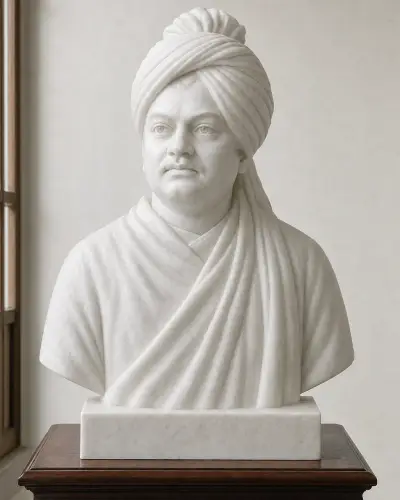
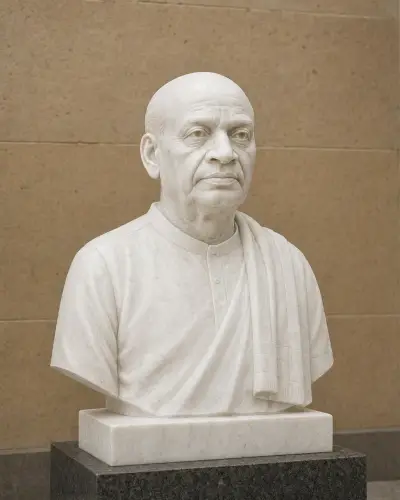
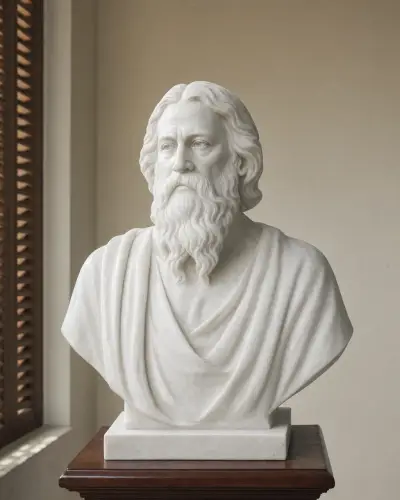
Lokmanya Bal Gangadhar Tilak Marble Bust Statue 21in
Master-carved Makrana white marble bust of Lokmanya Tilak, a 21-inch portrait in the Puneri pagdi, for schools, mandals and reading rooms.
Made to order. The pictures here are concept images. This is not a ready item. We get it made for you as per this design, as close as possible, in the size and stone you choose.
Want this design made for you?
Tell us the size, the stone and where it is going. We will send you a quote and a timeline.
Chat on WhatsAppWe'll respond within 5 minutes
About This Piece
The portrait: Tilak in the Puneri pagdi
Bal Gangadhar Tilak (1856 to 1920) is recognised before he is read: the tall Puneri pagdi, the heavy white moustache, the small round spectacles, the plain high-collared coat. This bust carries all four. It is cut at the chest in the classical portrait convention, so the weight of the piece falls entirely in the face: the level gaze and set jaw of the editor who ran Kesari and Mahratta out of Pune, revived the public Ganeshotsav in 1893, and gave the freedom movement the line "Swaraj is my birthright and I shall have it". The sculptor works from the well-known later photographs, by which time the moustache had gone white and the pagdi had become inseparable from the man.
Makrana white marble, and why a memorial asks for it
The stone is Makrana white marble, quarried in Nagaur district in Rajasthan. It comes from the same belt that supplied the Taj Mahal, which is why Indian commemorative sculpture has leaned on it for four centuries. Its grain is fine and crystalline rather than open, which is what lets a portrait hold its small edges: the wire rim of a spectacle arm, the crisp lip of a fold in the pagdi, the four buttons down the coat front. It is finished to a soft satin polish rather than a mirror, so the marble still reads as stone and the modelling across cheek and brow stays legible under hall lighting instead of dissolving into glare.
The 21-inch scale, the plinth, and where it stands
At 21 inches from the base of the plinth to the crown of the pagdi, the bust sits just under life size, with enough presence to close the end of a school corridor or hold a mandal's stage, yet contained enough for a reading-room console. It measures roughly 13 inches across the shoulders with a 10-inch depth and weighs about 38 kg finished, so it belongs on a masonry plinth or a pedestal rated for that load rather than a light display table. Set that pedestal at 40 to 45 inches and Tilak's eyes meet a standing adult's, which is how a commemorative bust is meant to be met. Leave a clear foot of plain wall behind it, because the silhouette of the pagdi is the signature of the whole piece.
Make this Tilak bust yours
We design the piece with you before the block is cut. The master sculptors we work with can take the bust to 24 or 30 inches for a hall of that scale, cut it in Vietnam white marble or black stone instead of Makrana, or leave a recessed panel on the plinth face for an engraved name, dates or a dedication line in Devanagari. Send us the reference photograph your committee has settled on, and we will brief it in and follow the work through to the day it is installed.
Specifications
Pose
Head-and-shoulders portrait bust in the Puneri pagdi
Color
White
Finish
Soft polish (satin)
Material
Makrana White Marble
Ideal For
Schools and colleges, Mandal and trust offices, Reading rooms and libraries, Commemorative and memorial installations
Weight In Kg
38
Depth In Inches
10
Width In Inches
13
Height In Inches
21
Region Or Tradition
Indian / Maharashtrian (Pune, Indian freedom movement)